
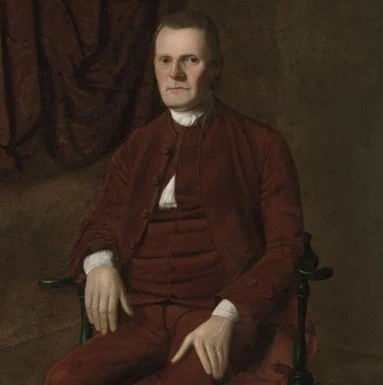
Roger Sherman was the only person to sign all of the Four Great State Papers of the United States.
Read MoreRoger Sherman portrait by Ralph Earl - Yale University Art Gallery, Public Domain
The Document You May Not Have Heard Of
The Document You May Not Have Heard Of
by Lawrence W. Reed
What are the Four Great State Papers of the United States of America?
I’ll wager that most Americans could name one of them, maybe half could name two, a single-digit percentage could come up with three but almost nobody could name the fourth.
What are known primarily by legal scholars as the Four Great State Papers are, in order of chronological appearance, The Continental Association (1774), the Declaration of Independence (1776), the Articles of Confederation (1781) and the Constitution (1787). It’s the first one that few people would likely know.
The Continental Association was the most notable product of the First Continental Congress, which met in Carpenter’s Hall in Philadelphia in the months of September and October 1774. A three-page document, it called for a boycott of British goods until the Parliament in London repealed the Coercive Acts that punished Massachusetts for the Boston Tea Party of December 1773. You can read it in its entirety here.
No major nation had yet formally opposed the slave trade, yet the Continental Association included this remarkable statement:
We will neither import nor purchase any slave imported after the first day of December next; after which time, we will wholly discontinue the slave trade, and will neither be concerned in it ourselves, nor will we hire our vessels, nor sell our commodities or manufactures to those who are concerned in it.
Twelve of the 13 colonies sent delegates to the First Continental Congress. Georgia was the only one that did not, a testament to strong Loyalist (pro-British) sentiment still present there. The Congress is significant in American history because it represented unified colonial efforts to challenge British authority and coordinate collective resistance. It established a precedent for intercolonial cooperation and communication, laying the groundwork for the Second Continental Congress, which formed the following May after the skirmishes at Lexington and Concord.
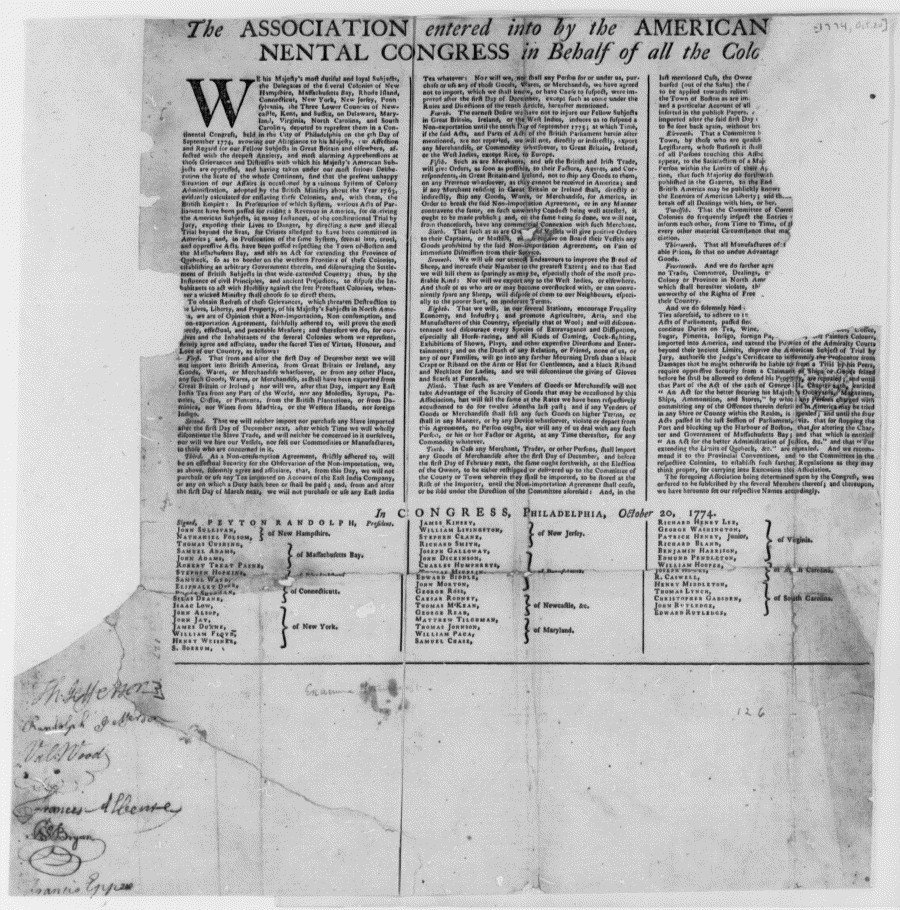
The Constitental Association, Library of Congress
Proposed by Richard Henry Lee of Virginia, the Congress scheduled the boycott to begin on December 1, 1774. It proved immediately effective. Imports from Britain plunged precipitously. If the Coercive Acts were not repealed, then a ban on exports to Britain was to take effect on September 10, 1775.
So riled up over the Coercive Acts were colonists from North to South that voluntary compliance with the ban on imports was impressive all by itself. But the Congress backed it up by creating Committees of Inspection in each colony to monitor and enforce it.
Thomas Jefferson, a signatory to the Continental Association, had ordered fourteen sash windows from London before the boycott took effect but they arrived once the ban commenced. He left the decision to local authorities, who ultimately decided not to seize or destroy the windows. Others in the same situation were not so lucky.
The boycott was superseded by the outbreak of war in the spring of 1775, and the Declaration of Independence a year later, but its effectiveness made it clear to the Brits that America was deadly serious about resisting London’s intrusiveness.
The name of another Founding Father deserves mention here, Roger Sherman of Connecticut. He was the only person who signed all Four Great State Papers of the United States and remains one of the more underappreciated Founders. He opposed slavery and fiat paper money and authored the Connecticut Compromise at the 1787 Constitutional Convention whereby representation in the House would be apportioned by population and in the Senate by two members for every state regardless of size. He ultimately supported ratification of the Constitution when provisions to strengthen liberty and the powers of the states were incorporated.
Roger Sherman said a great many wise things. I close with this quote from him:
We must never forget the sacrifices of our ancestors who fought for our freedom and independence.
For additional information, see:
Articles of Association, Text by American History Central
(Lawrence W. Reed is President Emeritus, Humphreys Family Senior Fellow, and Ron Manners Global Ambassador for Liberty at the Foundation for Economic Education in Atlanta, GA.)