
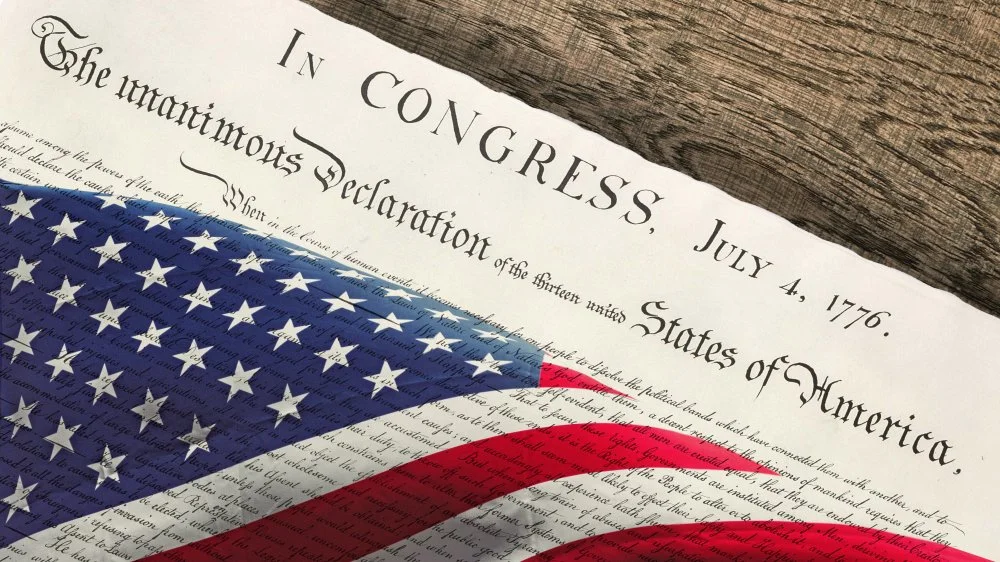
Very few Americans know that in everything but name, the Congress had effectively endorsed American independence nearly two months earlier—on May 15.
Read MoreIndependence Day: May 15 or July 4?
Independence Day: May 15 or July 4?
By Lawrence W. Reed
The Second Continental Congress voted for independence from Great Britain on July 2, 1776, but most Americans know we celebrate July 4 because that’s the date the Declaration of Independence itself was approved and published. Very few Americans know, however, that in everything but name, the Congress had effectively endorsed American independence nearly two months earlier—on May 15. Before I tell you that story, allow me to put the momentous occasion in its historical context.
After more than a decade of rising tensions, war between the colonies and Britain broke out in April 1775, when Captain John Parker ordered his patriot militia to “stand your ground” as British regulars approached Lexington, Massachusetts. Someone fired the famous “shot heard ‘round the world” and within minutes, eight Americans lay dead.
Recognizing that repeated efforts to keep the peace had been rebuffed by London, the Second Continental Congress in May ordered the creation of the Continental Army and made Virginia’s George Washington its Commander-in-Chief. One month later, Americans may have lost the Battle of Bunker Hill but not before impressing the British with their courage on the battlefield.
In July 1775, the Congress sent a final plea for reconciliation, known as the Olive Branch Petition, to King George III. He refused to read it when it arrived on September 1, in part because he had already declared the colonies to be in open revolt in August.
It was in October 1775 that the King gave the first indication of his intent to hire large numbers of foreign (mostly German) mercenaries to help Britain put down the rebellion. Some 30,000 were eventually employed to fight alongside the British army. In December, the King cut off all trade between Britain and the colonies, imposed a naval blockade, and ordered the seizure of American ships.
January 1776 produced two big developments: Thomas Paine’s Common Sense galvanized Americans to stand up for their rights and reject the very idea of monarchy, and Henry Knox managed the herculean feat of transporting 60 tons of artillery 300 miles from Fort Ticonderoga to Dorchester Heights overlooking Boston. By mid-March, Washington’s army with Knox’s cannons forced the British to evacuate the city.
Then, North Carolina in April 1776 became the first colony to instruct its delegates to the Congress to support a resolution for independence. Three weeks later, the Congress shuddered at the first confirmation of German mercenaries bound for North America.
So, by mid-spring 1776, a full-scale war was well underway. A peaceful settlement of differences seemed all but impossible. Independence was a practical fact, though Americans would still have to formally declare it and shed plenty more blood to keep it.
That’s the backdrop to the event in Congress on May 15, 1776, alluded to in my opening paragraph.
On that date, Congress approved a resolution calling upon the 13 colonies to set up new, independent governments, each with its own constitution. John Adams described it as “the most important resolution that ever was taken in America.” He knew what he was talking about and, in fact, it was Adams himself who wrote resolution’s preamble, which read as follows:
Whereas his Britannic Majesty, in conjunction with the lords and commons of Great Britain, has, by a late act of Parliament, excluded the inhabitants of these United Colonies from the protection of his crown; And whereas, no answer, whatever, to the humble petitions of the colonies for redress of grievances and reconciliation with Great Britain, has been or is likely to be given; but, the whole force of that kingdom, aided by foreign mercenaries, is to be exerted for the destruction of the good people of these colonies; And whereas, it appears absolutely irreconcilable to reason and good Conscience, for the people of these colonies now to take the oaths and affirmations necessary for the support of any government under the crown of Great Britain, and it is necessary that the exercise of every kind of authority under the said crown should be totally suppressed, and all the powers of government exerted, under the authority of the people of the colonies, for the preservation of internal peace, virtue, and good order, as well as for the defense of their lives, liberties, and properties, against the hostile invasions and cruel depredations of their enemies.
Neither the Adams preamble nor the rest of the resolution spoke of independence by name, but independence was clearly the purpose. You don’t call for the total suppression of British government, the erection of new governments in its place, and engage in open warfare at the same time, if all you intend to do is to raise a fuss and then embrace a compromise.
Historian Emily Sneff, whose specialty is the American founding era, produced a marvelous new book in 2026 titled, When the Declaration of Independence Was News. She recounts how Adams responded when a fellow Founding Father named James Duane of New York labeled the May 15 resolution as “a Machine for the fabrication of Independence.” The Boston patriot and future U.S. president “smiled and replied, ‘I thought it was Independence itself; but We must have it with more formality yet.’”
The delegations from twelve of the thirteen colonies approved the resolution, Georgia being the only colony whose representatives would not arrive in Philadelphia until five days later. Nonetheless, writes Sneff,
With the May 15 Resolution, the Congress had taken a step that was meant to bring all the colonies into sync with one another and to publicly acknowledge, for the first time, that the king had forced the Congress to move.
To the British, the Declaration of Independence of July 4 was anti-climactic. The government in London, at war with America for over a year, already regarded the colonies as hell-bent on independence. And at least one foreign leader and British ally, King José I of Portugal, certainly saw the May 15 resolution the same way: he forbade all American vessels from entering Portuguese ports.
The fact of Georgia’s absence from the May 15 vote is not sufficient reason to reject the resolution as a de facto call for independence. After all, the vote to approve Richard Henry Lee’s resolution on July 2 was not unanimous either; New York’s delegation abstained because it hadn’t yet been instructed by the legislature in Albany. The Declaration of Independence would not become unanimous until July 9, when New York’s representatives voted in the affirmative.
As John Adams hinted shortly after the May 15 Resolution passed, the whole business of independence still needed a more formal and decisive statement. That’s what the world got when it read the Declaration of Independence in early July. The aims of the two documents were the same, but the latter made the point with much more clarity and profundity. America’s attachment to its mother country was forever broken, a fact affirmed seven years later when Britain surrendered. With unmatched eloquence, the Declaration informed the world that man’s natural rights are more important than the whims of any government, and a government that makes war on those rights deserves nothing less than capital punishment.
While I applaud the May 15 Resolution, I think July 4 is the more appropriate date for an American “Independence Day.” It was the Declaration that settled the question and gave us immortal words such as “all men are created equal” to boot. God bless America!
(Lawrence W. Reed is President Emeritus, Humphreys Family Senior Fellow, and Ron Manners Global Ambassador for Liberty at the Foundation for Economic Education in Atlanta, Georgia.)