
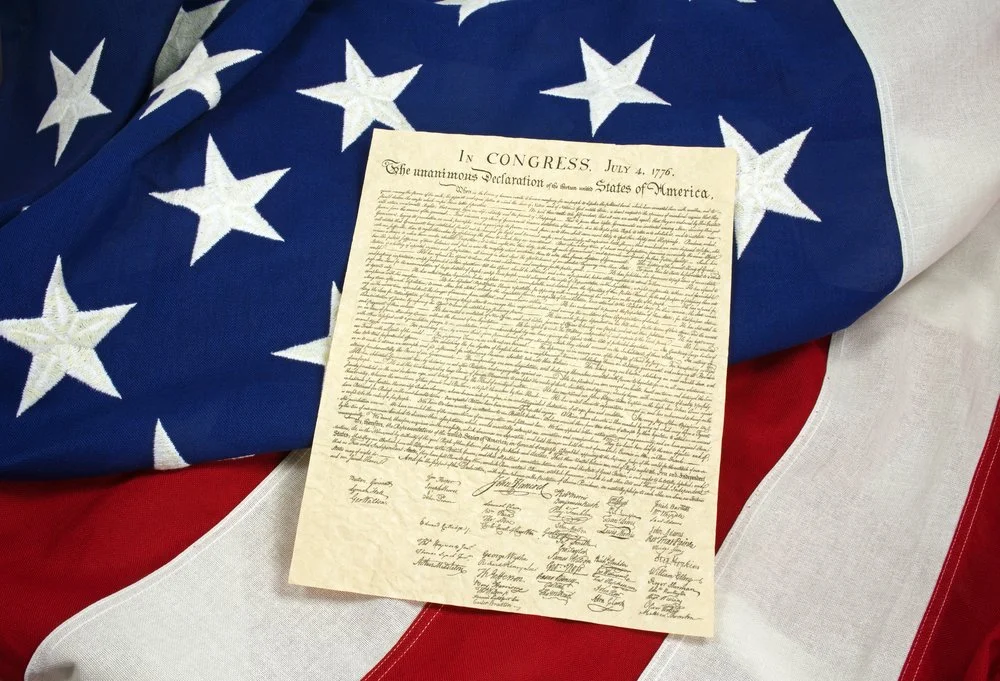
What Al Sharpton won’t tell you is that the Framers, armed with the promise expressed in the Declaration of Independence, did as much or more to put human bondage on the road to extinction than any other generation anywhere. Spanish version: https://tinyurl.com/5dvv9jx6.
Read MoreInconvenient Truths About Slavery
Inconvenient Truths About Slavery
By Lawrence W. Reed
America’s 250th anniversary is only a few weeks away. Are you planning anything special for it?
John Adams, a leading Founder and later second U.S. President, thought that the 4th of July “ought to be solemnized with pomp and parade, with shows, games, sports, guns, bells, bonfires and illuminations, from one end of this continent to the other, from this time forward forever more.”
Al Sharpton, the race-baiting hustler who promotes division, grievance, and groupthink for a living, is talking about holding a demonstration in Philadelphia—not to celebrate but, rather, to protest the anniversary. He says black Americans were not emancipated until 1863, so there’s nothing for them to do on July 4 but complain.
Adams was precisely right. What the Founders did in Philadelphia 250 years ago was a spectacular achievement unparalleled in political history. They pushed the world further toward universal freedom than any previous generation had done and probably as much as they could get away with, given the circumstances.
Sharpton, however, lacks the character to rise above his selfishness and recognize historical truth. He has sullied a lifetime playing the race card to line his pockets.
Here’s why the slavery in America’s past is no reason to sulk on July 4:
America is not exceptional because we had slavery. We are, however, exceptional because of the lengths to which we went to end it—inspired by the words of the very document Sharpton can’t bring himself to celebrate.
Before the dawn of the 19th Century, you could count on one hand the number of countries where slavery never existed. It dates back at least as far as 3500 B.C. in ancient Mesopotamia. This includes every country of the African continent. Indeed, even at the height of the transatlantic slave trade in the 18th century, white Europeans almost never dispatched raiding parties into the African interior to capture people and enslave them. Local tribes did the initial dirty work by kidnapping people and then selling them to foreign slavers at dockside. Slavery of Africans by Africans within Africa was big business for centuries.
Slavery was so common the world over for so long that Haiti is credited with being the first nation in history to abolish it. And that didn’t happen until 1804! By then, eight American states had already abolished it (in the North and mid-Atlantic) or passed laws to phase it out. Vermont (not one of the original 13 colonies) embraced abolition in 1777, when it was an independent republic and well before it became a state in 1791.
Under the Articles of Confederation in 1787, the American Congress banned slavery north of the Ohio River in the Northwest Territories. Only one member voted against it. President George Washington signed it into law.
The first African country to abolish slavery was the Seychelles, and that did not take effect until 1837. Human sacrifice was commonplace in West African states through the 1800s and the great majority of its victims were slaves. The last African country to get rid of slavery was Mauritania, which formally ended it only 45 years ago, in 1981.
Denmark didn’t get around to ending slavery in its Caribbean colonies until 1848.
A single-digit percentage of kidnapped Africans ended up in North America. Nearly half of them were sent to Brazil, which finally abolished slavery in 1888, more than two decades after the American Civil War.
To be sure, the U.S. Constitution did not immediately abolish slavery at the national level (even though half the states had done so). The Framers of that document compromised on the issue for the sake of union. With near unanimity, historians believe abolition in 1787 would have split the country in two right from the start.
What Al Sharpton won’t tell you is that the Framers, armed with the promise expressed in the Declaration of Independence, did as much or more to put human bondage on the road to extinction than any other generation anywhere. They refused to codify it by name in the Constitution. They included a provision that outlawed the transatlantic trade in slaves beginning in 1808.
“But didn’t the Constitution recognize each black slave as only three-fifths of a person?” you might ask. Yes it did, but that too was a compromise, and it was only in regard to determining population for apportioning representation in the federal Congress. It was not a statement against the “worth” of black individuals vis-à-vis whites.
Southern slave states wanted all slaves to count in the census because it would result in greater representation in the Congress without giving slaves any rights. Northern states generally argued that no slaves should count toward representation because they weren’t free to vote. The three-fifths compromise limited Southern representation compared to what slaveholders had hoped for.
It wasn’t only whites who possessed black slaves in early America. Free black people owned fellow blacks in every one of the 13 original states and later in most other states. As late as 1830, according to Harvard historian Henry Louis Gates, 3,776 free American blacks owned 12,907 slaves. Moreover, in 1860, Native American tribes owned some 8,000 black slaves; the Cherokee Indians alone possessed about 4,600. It wasn’t always the whites-against-blacks matter that Al Sharpton claims.
In his superb book, Vindicating the Founders, historian Thomas G. West argues decisively that “The political logic of the [American] Revolution pointed inexorably to the eventual abolition of slavery.” Moreover, writes West,
In the short term, slavery was bound to continue, with the Constitution or without. If liberty for anyone was to have a future in America, the indispensable first step was a stronger national government on a democratic basis. Even the Anti-Federalist opponents of the Constitution admitted this much…
The Founders [or at least most of them] believed that their compromises with slavery would be corrected in the course of American history after the union was formed. Their belief turned out to be true, although the new birth of freedom proved to be less inevitable and more costly than they anticipated. The Civil War fulfilled the antislavery promise of the American founding.
When ideas change, as they increasingly did on the question of slavery in the late 1700s, a few people embrace new ones without hesitation; others are slow to do so; still others may never shake old ways of thinking, for reasons more complicated than the quick-to-judge will admit. Even Benjamin Franklin eventually evolved from an indifferent owner of a slave or two to a full-throated abolitionist. If you think you’re better than that, try to answer this question honestly: Do you know for a fact that if you had been born in 1700 instead of, say, 2000, you would have become an abolitionist?
In the middle of the 18th century, almost nobody anywhere regarded slavery as wrong or even unusual. But around the same time, sentiment on the matter was beginning to shift. By asserting that “all men are created equal,” the Declaration of Independence put America on the cutting edge of a nascent abolitionist movement. Opponents of slavery, including Frederick Douglass, used the language of the Declaration to point out the inconsistency and hypocrisy of latecomers to the abolitionist cause. He argued that both the Declaration and the Constitution were “liberty documents” that later generations of Americans needed to live up to. (See Sources and Additional Information below).
In a single day in Philadelphia, every one of America’s Founders accomplished more for the cause of human liberty than Al Sharpton will likely accomplish in his entire lifetime. I doubt he can honestly claim to have ever liberated anybody.
All Americans should celebrate the country’s 250th with a patriotic fervor worthy of the documents that made America possible.
That goes for you too, Al.
Sources and Additional Information:
Vindicating the Founders by Thomas G. West
Recognizing Hard Truths About Slavery by Lawrence W. Reed
The History of Slavery You Probably Weren’t Taught in School by Lawrence W. Reed
An Open Letter to All Americans by Lawrence W. Reed
How the Slaveholding Founders Really Felt About Slavery by Timothy Sandefur
A Note on Slavery and the American Founding by Matthew Spalding
Defending the Constitution: Why the Founders Couldn’t Abolish Slavery by Rob Natelson
Slavery, Equality, and the American Revolution by Yuval Levin
Frederick Douglass’s Fourth of July Speech (1852)
The Truth About Slavery and America by Jason Riley
The Grimké Sisters: The First American Women Who Labored to Ensure Freedom for All by Lawrence W. Reed
(Lawrence W. Reed is President Emeritus, Humphreys Family Senior Fellow, and Ron Manners Global Ambassador for Liberty at the Foundation for Economic Education in Atlanta, Georgia. He blogs at www.lawrencewreed.com.)