
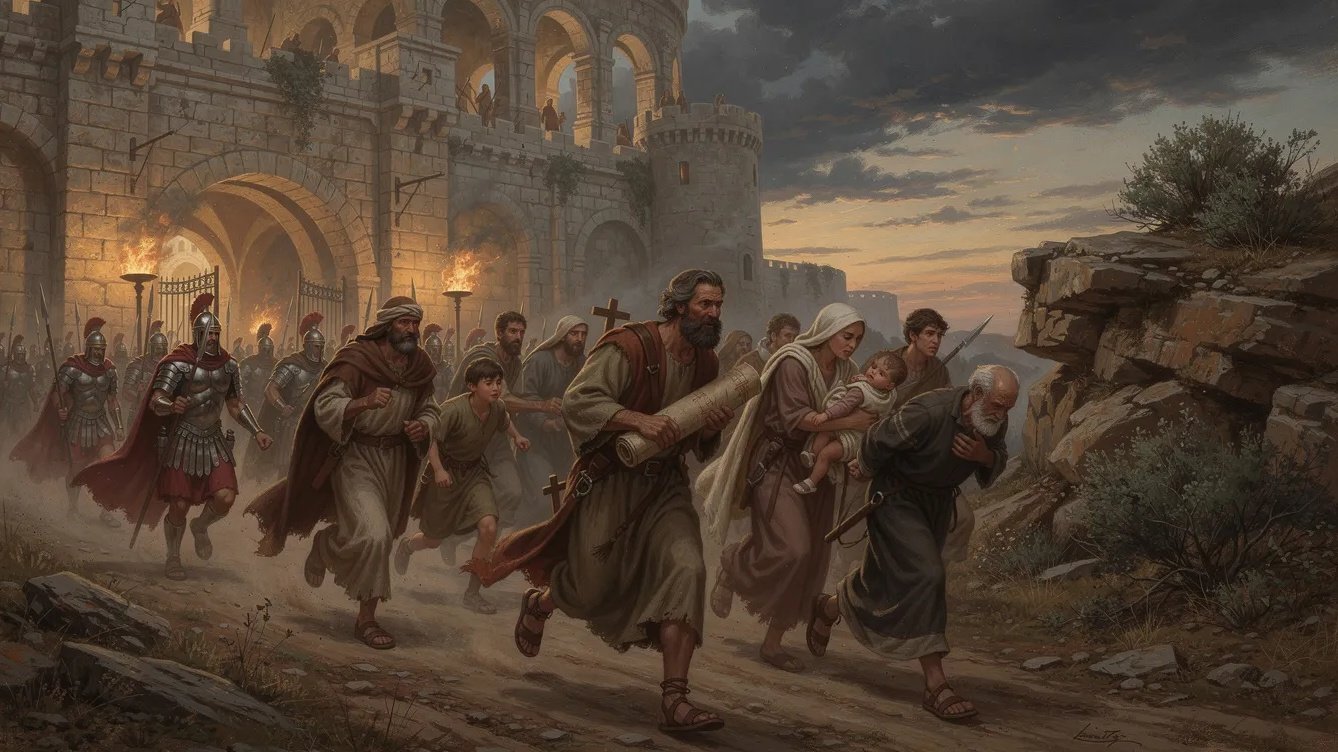
Christianity not only survived the evil Diocletianic Persecution, it emerged stronger than ever, underscoring the prophecy of the early Christian author Tertullian that “the blood of the martyrs is the seed of the church.”
Read MoreApril 30 in Roman History
April 30 in Roman History
By Lawrence W. Reed
“It’s always darkest before the dawn,” wrote the English theologian Thomas Fuller in 1650. In the nearly four centuries since, writers have deployed the phrase countless times, often to encourage optimism that things may soon change for the better.
My interest in ancient Roman history prompts me to cite a notable occasion when a very dark moment ended (on this very date, April 30), leading to an astonishing reversal only two years later.
By the time of the birth of Christ, the old Roman Republic had given way to an imperial autocracy. For nearly five centuries thereafter, emperors ruled and both individual liberties and the rule of law vanished at their whim. When the Great Fire destroyed three-quarters of the city of Rome in 64 AD, the megalomaniacal Nero blamed the Christians. He burned them as human torches. The more “tolerant” of later emperors would, at best, look the other way as local mobs and officials conducted pogroms against the followers of Christ.
Christianity nonetheless grew relentlessly throughout the Roman Empire, even when driven underground in the worst of times. The most extensive persecution began on February 23 in 303 under Diocletian and his three co-emperors Maximian, Galerius, and Constantius. Christians were purged, plundered, and slayed by the thousands in a genocidal campaign to wipe out the faith.
Diocletian began by commanding the destruction of the newly built Christian church at Nicomedia, in present-day Turkey. Its scriptures were to be set aflame and its treasures confiscated. A day later, he issued an edict that targeted senior Christian clerics and ordered a wider seizure of Christian property. The contemporary Christian historian Eusebius recorded that followers of the faith were prohibited from assembling for worship as agents of the emperor destroyed scriptures, books, and churches across the empire. So many Christians were incarcerated, Eusebius revealed, that prisons were emptied of violent criminals to make room for them.
The darkness Diocletian wrought officially ended on April 30 in the year 311 when Emperor Galerius, mortally ill with a horribly gruesome disease, suddenly decreed that Christians could practice their faith once again. Days before he died a painful death, Galerius asked that Christians pray for him. In a last act, he granted toleration to the faith, though he did not restore confiscated property.
Christianity not only survived the evil Diocletianic Persecution, it emerged stronger than ever, underscoring the prophecy of the early Christian author Tertullian that “the blood of the martyrs is the seed of the church.”
Ten years to the very month after it started, the darkness gave way to dawn. In February 313, the new Emperor Constantine issued the Edict of Milan. For the first time, the state recognized the legal status of Christianity as a protected faith. It ordered the return of confiscated meeting places and other Christian properties and for compensation to be paid by the state to the current owners.
Among historians, the question of who was the worst Roman emperor is still debated. I nominated Caligula for the “honor” in an article a few years ago. Diocletian surely ranks among the most deplorable, not only for his persecution of the Christians, but also for his comprehensive price controls that crushed the Roman economy.
Admiration is due to the faithful who endured horrific persecution and never sacrificed their beliefs to satisfy evil men of fleeting, earthly power.
For additional information, see:
Caligula: Plumbing the Depths of Ancient Tyranny by Lawrence W. Reed
9 Worst Roman Emperors: Tyranny, Chaos, and Corruption by History Skills
The Slow-Motion Financial Suicide of the Roman Empire by Lawrence W. Reed and Marc Hyden
What Gibbon Got Wrong by Lawrence W. Reed
Modern Parallels to the Fall of Rome (video) by Lawrence W. Reed
Can a Free Society Survive Without a Spiritual Foundation? by Lawrence W. Reed
#####
(Lawrence W. Reed is President Emeritus, Humphreys Family Senior Fellow, and Ron Manners Global Ambassador for Liberty at the Foundation for Economic Education in Atlanta, Georgia.)