
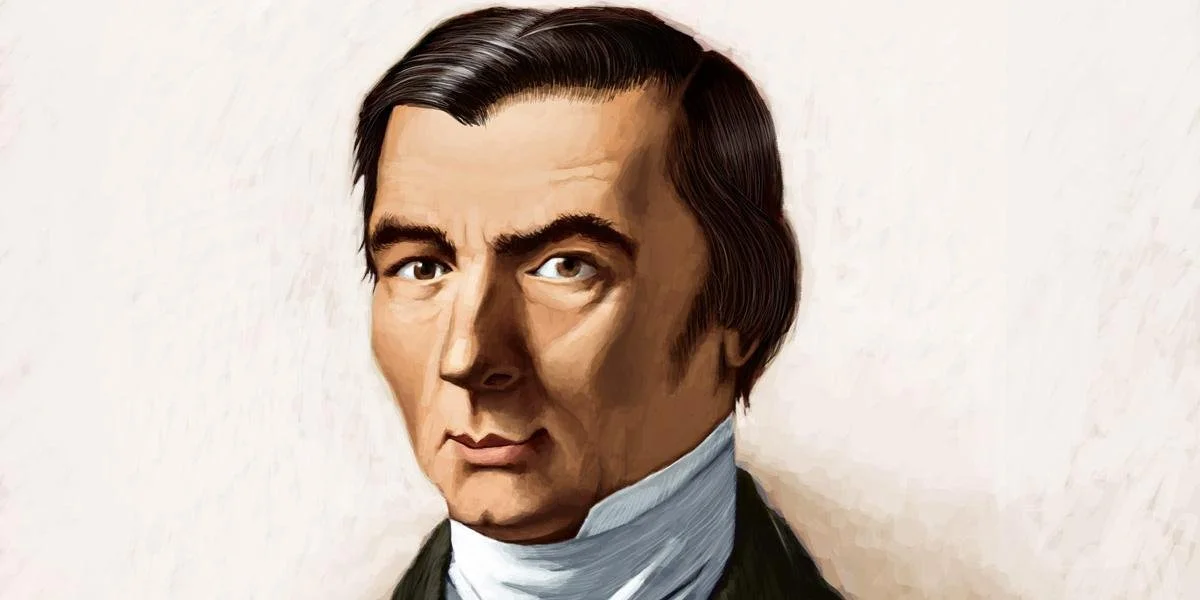
To his last breath, he mustered great eloquence to assault the arrogance of socialism and to defend the virtues of liberty. Article also appears here: https://fee.org/articles/the-life-of-frederic-bastiat/.
Read MoreThe Life of Frederic Bastiat, a Real Hero for Liberty
The Life of Frederic Bastiat
By Lawrence W. Reed
Two hundred and fifty years ago this month, the Scottish philosopher and economist Adam Smith gifted the world a monumental work, An Inquiry Into the Nature and Causes of the Wealth of Nations. Because of its impact on the world, resonating to this very day, it belongs on any list of the 100 most influential books ever written.
Great teachers produce great students. Smith produced too many to count, but one in particular stands out as extraordinary for his eloquence, his storytelling, and his passion for freedom and free markets. That would be Frederic Bastiat, best known for his very last of many books, The Law. It is in that mesmerizing little volume, readable in an evening, that he declared unequivocally, “No legal plunder! This is the principle of justice, peace, order, stability, harmony, and logic. Until the day of my death, I shall proclaim this principle with all the force of my lungs!”
It was also in The Law that Bastiat enunciated this vital concept: “Life, liberty, and property do not exist because men have made laws. On the contrary, it was the fact that life, liberty, and property existed beforehand that caused men to make laws in the first place.”
At the Foundation for Economic Education, we possess a special affinity for Frederic Bastiat. When his work was largely forgotten in France and unknown in America, it was FEE staffer Dean Russell who dusted him off, translated his books, and introduced him to an English-speaking audience a full century after his death in 1850. In addition to The Law and Dean Russell’s biography of him (see sources, below), FEE also published Bastiat’s Economic Sophisms and Economic Harmonies.
Bastiat never sat in any of Adam Smith’s classrooms. He was born in Bayonne, France, on June 30, 1801, more than a decade after Smith passed away in 1790. Bastiat was a student of Smith in the intellectual sense. He identified the Scot as one of the main influences over his own thinking, along with the French economist Jean Baptiste Say, the school of Enlightenment thinkers known as the Physiocrats, and the French liberal Charles Dunoyer.
Say is remembered primarily for “Say’s Law” (often explained as “supply creates its own demand”). When Bastiat founded a newspaper, Le Libre-Echange (“Free Trade”) in 1846, he printed a version of Say’s Law on the masthead of every edition. The Physiocrats, though they erred in over-emphasizing agriculture, were early proponents of the natural law and market forces that Smith synthesized into his concept of “the invisible hand.”
Bastiat’s father died when the youngster was only seven. His mother passed away two years later. At the age of nine, he went to live with his paternal grandfather. The family’s history of success in the export and banking businesses meant that young Frederic could enroll in good schools, where he learned to speak Spanish, Italian, and English as well as his native French.
When he was 26 (in 1827), he stumbled across a copy of Benjamin Franklin’s Poor Richard’s Almanack, which he regarded as “a real treasure” because of Franklin’s use of humor and brevity to illuminate serious principles.
Bastiat’s later writings bear a strong resemblance to Franklin’s style. Good examples are The Candlemakers’ Petition, That Which is Seen and That Which is Not Seen, The Parable of the Broken Window, and his use of Daniel Defoe’s Robinson Crusoe character to illustrate an important economic principle.
When Bastiat’s grandfather died in 1825, the young man inherited the family estate. For the next twenty years, he lived as a gentleman farmer and part-time scholar. Increasingly over that period, he relied on others to manage the property so he would have time to pursue his scholarly passions. By the time of the Revolution of 1830, which dethroned Charles X and introduced a constitutional monarchy under Louis Philippe, Bastiat was a principled advocate for laissez-faire—a name often bestowed upon the philosophy of limited government, private property, competition, entrepreneurship, and individual rights. He was disappointed when the Revolution fell short of producing a truly liberal order along laissez-faire lines.
He tasted public life for the first time when, in 1831, he was elected a justice of the peace in the town of Mugron. No doubt he learned some machinations of the law as a kind of insider, and many discussions with friends honed his talents as a debater. It was his ongoing study of political economy, however, that more fully equipped him for the burst of activity that would define the remarkable final years of his short life.
Bastiat’s first published article appeared in April 1834. The subject was tariffs, which he regarded as taxes on economic progress that benefited the protected at everyone else’s expense. He challenged a group of manufacturers who had called for selective (and self-serving) reductions in tariffs by appealing to principled consistency:
You demand that all protection be abolished on primary materials, such as agricultural products, but that protection must be continued for manufactured articles. I do not defend the protection you attack, but attack the protection you defend. You demand privilege for a few; I demand liberty for all.
Meanwhile, across the English Channel, growing sentiments for tariff reduction were coalescing into a powerful, grassroots movement. In 1839, Richard Cobden and John Bright co-founded the Anti-Corn Law League and turned it into the most effective lobby in Britain since the anti-slavery organizations of Thomas Clarkson and William Wilberforce. Just seven years later, the League triumphed when Parliament repealed Britain’s onerous taxes on the importation of grain. Bastiat, by then a personal friend of Cobden’s, was inspired to create a French counterpart, the Free Trade Association, to accomplish a similar objective for France. He moved in 1846 to Paris, where he burst onto the political scene as ready as anybody ever was to fight for economic liberty.
What was Bastiat like as a person? In his biography of the Frenchman, Dean Russell offered these observations from a Bastiat contemporary, Louis Reybaud:
He was a typical example of the provincial scholar, simple in his manner and plain in his attire. But under that country costume and good-natured attitude, there was a natural dignity of deportment and flashes of a keen intelligence, and one quickly discovered an honest heart and a generous soul. His eyes, especially, were lighted up with singular brightness and fire. His emaciated features and flushed complexion betrayed already the presence of the disease [tuberculosis] that was destined to kill him in a few years. His voice was hollow and in marked contrast to the vivacity of his ideas and the quickness of his gestures. . . . He never thought of how many days he had to live, but of how he might employ them well.
While an angry Karl Marx was scribbling nonsense and half-truths about class warfare, the optimistic Frederic Bastiat was busy explaining why capital and labor are complementary factors of production, each one benefiting from the contributions of the other. Where Marx preached conflict and foresaw impoverishment of the working classes; Bastiat saw a harmony of interests that would produce peace and prosperity for everybody. The improving working conditions, falling prices, the ever greater abundance of goods and a much higher standard of living for the average worker in 1900 compared to 1800 proved far more in line with Bastiat’s prophecies than with Marx’s gloomy outlook.
Revolution came to France once again, in February 1848, two years after Bastiat had moved to Paris. Sadly, this one produced a new regime hostile to free trade. Forced by the unfortunate turn of events to set his free trade organization aside, Bastiat turned his attention to a new threat gaining ground, socialism. It was, in many ways, the same fight but against a foe more evil than tariffs. Protectionism involved the use of government force to inhibit trade; socialism proposed the use of government force to inhibit almost everything.
After a brief campaign, Bastiat was elected in April 1848 as a deputy to the National Assembly. He would serve in that capacity until his death from tuberculosis on Christmas Eve, 1850. In that last year of his life, he managed to publish the work for which he remains best known, the one that even today transforms the thinking of many first-time readers, The Law.
As a legislator, Bastiat argued furiously against robbing Peter to pay Paul, the erection of barriers to productive enterprise, and the spendthrift habits of his vote-buying colleagues. He won over a few and lost most of his battles but never compromised his honor or his principles. To his last breath, he mustered great eloquence to assault the arrogance of socialism and to defend the virtues of liberty. Here is one of my favorite Bastiat quotes to that effect:
If the natural tendencies of mankind are so bad that it is not safe to permit people to be free, how is it that the tendencies of these organizers are always good? Do not the legislators and their appointed agents also belong to the human race? Or do they believe that they themselves are made of a finer clay than the rest of mankind?
In late 1850, Bastiat’s doctors sent him to Italy for treatment of his advanced illness. On his deathbed, he summoned friends to his side and uttered his last words, “Truth, truth.” He is buried at the church of San Luigi dei Francesi in Rome. France has never since produced a man or woman more principled or eloquent on behalf of human freedom and good government than he was.
When Bastiat died in 1850, he knew the prospects for France to drastically slash its trade barriers were remote, at least in the near term. But Cobden carried on in England, and another close friend of Bastiat’s in France, Michel Chevalier, who had converted to the free trade cause due to Bastiat’s influence, found himself representing Paris at the bargaining table with Cobden on the other side. Together, they negotiated the Cobden-Chevalier Treaty of 1860, the first modern free trade agreement. It ended the two countries’ tariffs on the main items of their trade, from French wine and silk to English coal and iron. Both men cited their friend Frederic Bastiat as a key inspiration.
How should we celebrate the sesquicentennial this month of Adam Smith’s The Wealth of Nations? Reading that great book is certainly one way. But another, one I think Smith himself would approve, would be to get better acquainted with one of the Scotsman’s greatest students, Frederic Bastiat. Toward that end, I provide links below.
Sources and additional information:
Reflecting on Adam Smith’s Wealth of Nations by Lawrence W. Reed
Adam Smith: Ideas Change the World by Lawrence W. Reed
Frederic Bastiat Deserves a Posthumous Nobel by Lawrence W. Reed
How To Create Like a Bastiat by Dan Sanchez
Advice for Presidential Candidates from Frederic Bastiat by Lawrence W. Reed
Disasters Should Remind Us of Bastiat’s Wisdom by Lawrence W. Reed
Richard Cobden: The Humble Farm Boy Who Made Britain Great by Lawrence W. Reed
The Case Against Protectionism by Lawrence W. Reed
The Log Tax is Hurting Both Canadians and Americans by Lawrence W. Reed
It’s More Important to BE American Than to BUY American by Lawrence W. Reed
Bastiat’s Life by Sheldon Richman
Why Bastiat is as Relevant as Ever by Mark Perry
Walter Williams on Bastiat by Walter Williams
How to See the Unseen Through the Broken Window Parable by Jonathan Newman
Bastiat for the Ages by Jeff Riggenbach
Why Bastiat Deserves to be in the Pantheon of Great Economic Theorists by Donald J. Boudreaux
Frederic Bastiat: Ideas and Influence by Dean Russell
Frederic Bastiat: A Man Alone by George C. Roche
Frederic Bastiat: Ingenious Champion of Liberty and Peace by Jim Powell
The Law by Frederic Bastiat
#####
(Lawrence W. Reed is President Emeritus, Humphreys Family Senior Fellow, and Ron Manners Global Ambassador for Liberty at the Foundation for Economic Education in Atlanta, Georgia. He blogs at www.lawrencewreed.com.)