
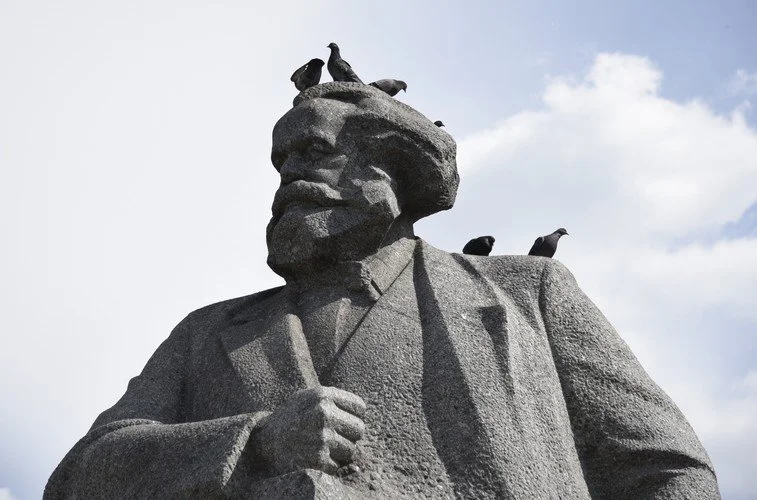
The pigeons in the picture got it right. Marx was a detestable fraud and he should have listened to his mother.
Read MoreThe Good Counsel of Mrs. Marx
The Good Counsel of Mrs. Marx
By Lawrence W. Reed
Everybody knows who Karl Marx was, which is itself a sad and shameful commentary on a lot of things—the gullibility of academia and the educational system, the dumb legacy media and sanctimonious punditocracy, and devious demagogues in politics who tell us if we just insert “democratic” in front of the socialism Marx advocated, it’ll somehow turn out OK.
That last point reminds me of one of the best memes I’ve ever run across. It featured a picture of a pile of dog crap on a sidewalk, covered with the colored sprinkles kids like on their ice cream. The caption read, “It’s not socialism, it’s democratic socialism!”
Sorry, it’s still a pile of dog crap no matter what you sprinkle on it. And its intellectual father, Karl Marx, was even worse as a human being—a vile racist, anti-Semitic liar. Probably demonic as well. In reviewing the late British historian Paul Johnson’s book, Intellectuals, John Barnes of the Detroit News noted that huge portions of Marx’s Das Kapital were “falsified to fit his own preconceived theories.”
That great work of Paul Johnson’s includes a powerful chapter on Marx. I cannot recommend it too highly (and same for the book as a whole). It demolishes Marx and his crackpot theories into a steaming pile with no sprinkles on top at all. One line in the Marx chapter has long commanded my attention. Johnson attributes it to Marx’s mother, who said she wished “Karl would accumulate capital instead of just writing about it.”
Every time I think of that line, it conjures up a vivid image. The smelly and unkempt Karl (he really was both, almost all the time) scribbling at his desk as his angry mother hovers over him. She’s had enough of his reprobate behavior and finally lets him have it: “Why don’t you get a job for a change, you pontificating lout! Accumulate some capital!” That’s a put-down for the ages.
But did she really say it? I decided to consult Johnson’s book again to find his source for the quote. It is, unfortunately, not footnoted.
That does not mean that Johnson made it up or that he didn’t have the authority to suggest it was true. He was a superb, prolific, and highly respected historian. He was a socialist himself as a young man, before his thinking matured and he embraced capitalism and Margaret Thatcher.
So I went surfing on the Internet to find out where the quote might have originated. It turns out that it’s not only true, but Karl himself alluded to it more than once.
One of Marx’s best-known biographers, David McLellan, authored Karl Marx: A Biography in 1973. In it, he wrote:
During 1867 Marx recognized that [Friedrich] Engels had given him “an enormous sum of money” but claimed that its effect was negated by his previous debts which amounted to £200. The next year, on his fiftieth birthday, he bitterly recalled his mother’s words, “if only Karl had made Capital, instead of just writing about it.”
Still, it would be more convincing if we could find something Karl wrote himself that would verify the quote. Lo and behold, such proof does exist! It’s on page 25 of Marx and Engels Collected Works, Volume 43, Letters 1868-70. There we find the following line in a letter from Marx to his benefactor (read: sucker) Friedrich Engels, reprinted here verbatim:
…[H]alf a century on my shoulders, and still a pauper. How right my mother was: If only Karell [Karl] had made capital instead of etc.
Now why would Marx abbreviate his mother’s advice with the Latin expression, et cetera, which means “and all the rest”? That makes sense only if he had reason to assume Engels would know what “the rest” was, which means that Marx probably shared the full quote with Engels before, probably more than once.
So Paul Johnson, as I suspected, was precisely right. Mrs. Marx offered sound counsel, though there’s no evidence that her prodigal, polemicist son ever took it.
Other observations from Johnson, confirmed by numerous scholars, reveal that Marx never showed the slightest interest (and he condemned those who did) in visiting the factories he railed against; in creating wealth by working for it, saving it, or investing it; or in getting to know and understand any real businessmen aside from the one sycophant (Engels) who subsidized him. Johnson summarizes,
The kind of facts which did not interest Marx were the facts to be discovered by examining the world and the people who live in it with his own eyes and ears. He was totally and incorrigibly deskbound. Nothing on earth would get him out of the library and the study.
Moreover, many of the concepts and memorable phrases Marx deployed (without attribution) were not original with him at all. He ripped them off from such men as Francois-Noel Babeuf and Karl Schapper. Indeed, it was Schapper and Jean-Paul Marat that Marx plagiarized when he famously declared, “Workers of the world, unite! You have nothing to lose but your chains.” Even “religion is the opium of the people” was stolen by Marx from Heinrich Heine.
He even postured as fortune-teller. He prophesied about where history was supposedly headed. He never told us if he used palm reading, tarot cards, a crystal ball, or entrails. He thought Russia would be the last place to undergo a socialist/communist revolution but it was the first. Maybe his Ouija board malfunctioned that day. (See https://mises.org/mises-wire/marxs-economic-forecasts-over-150-years-failure).
When Mrs. Marx upbraided Karl for sponging off her, Engels, and the world, she likely knew only the half of it. Just as he called for the theft of property, he was busy stealing words, phrases, and faulty ideas too.
If only Karl had listened to his mother, perhaps a hundred million people would not have perished at the hands of history’s regimes that took him seriously.
For additional information, see:
Intellectuals by Paul Johnson
The Devil and Karl Marx by Paul Kengor
Socialism: Force or Fantasy? by Lawrence W. Reed
Six Ways Socialism is Anti-Social by Lawrence W. Reed
Socialism: Science or Cyanide? by Lawrence W. Reed
The Big Problem with the Traditional Political Spectrum by Lawrence W. Reed
What the Nazis Had in Common with Other Collectivist Regimes by Lawrence W. Reed
Confessions of a Secret Marxist by Lawrence W. Reed
The Marxist Before Marx by Lawrence W. Reed
Paul Johnson on Why We Should Beware Intellectuals by Lawrence W. Reed