
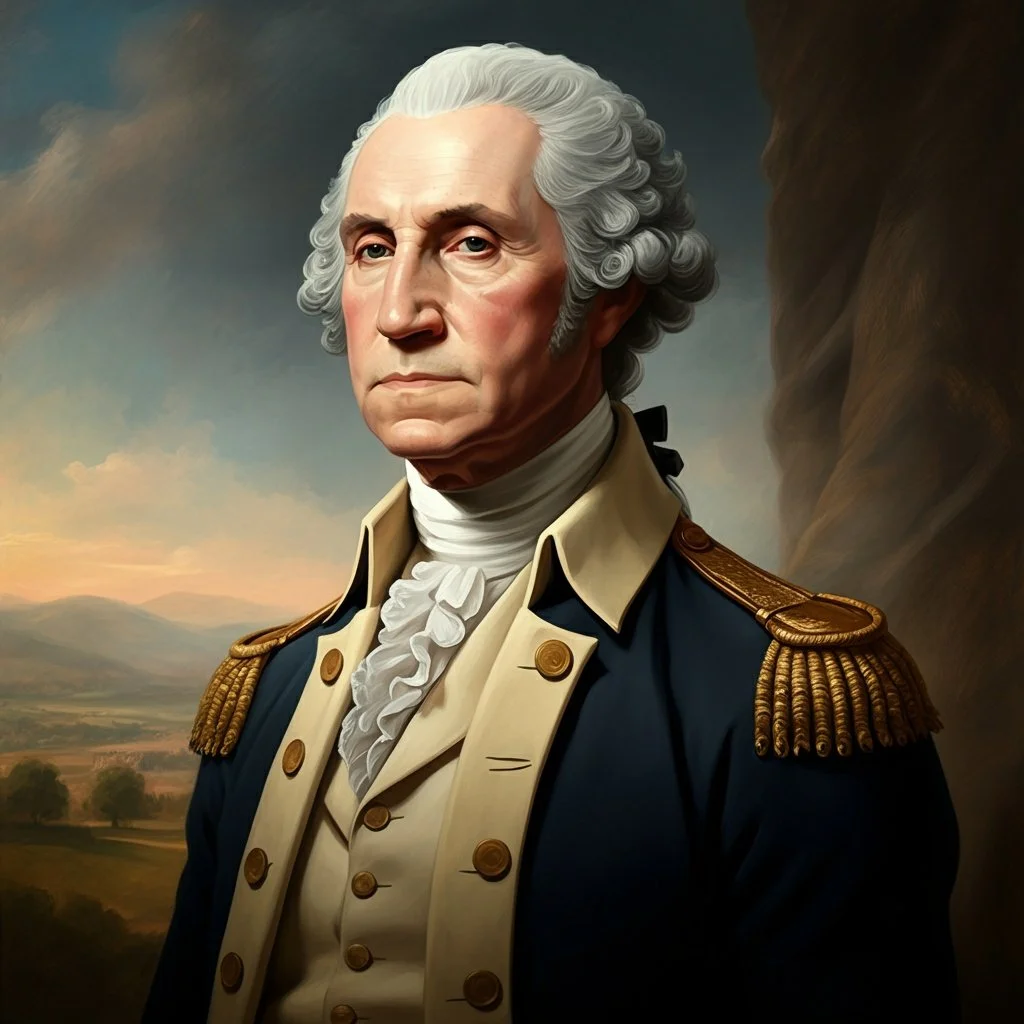
A war-time incident involving a lost dog underscored the biggest reason Washington won the war.
Read MoreThis article is drawn from a chapter in the author’s forthcoming book, Born of Ideas: How Principles, Faith, and Courage Forged America,” appearing in Spring 2026.
How Washington Won the War
How Washington Won the War
By Lawrence W. Reed
If you want to do well in a job interview, or impress high society at a fancy cocktail party, remember this useful tidbit of eighteenth-century advice: “Rinse not your mouth in the presence of others.”
A teenage George Washington copied that from a popular collection of maxims known in his day as “The 110 Rules of Civility.” It was number 101. With the earliest versions dating back to French Jesuits in the 1590s, that manual of good behavior shaped Washington’s character at a formative age. He was renowned in later life as a man of integrity who practiced the decorum, respectful discretion, and proper conduct outlined in that influential pamphlet. He certainly never gargled in front of anyone, so far as we know.
“Associate yourself with men of good quality if you esteem your own reputation; for ‘tis better to be alone than in bad company.” That was rule number 56. Washington seems to have lived up to that one too.
My personal favorite of all the rules is number 110, the very last one, because it conveys made Washington exceptional: “Labor to keep alive in your breast that little spark of celestial fire called conscience.”
As commander-in-chief of the Continental Army throughout America’s eight-year War for Independence, Washington led the country to a victory that seemed beyond reach in the early stages. His lost battles outnumbered his wins by more than two-to-one. How did he manage to keep thousands of regular soldiers and militia on the same page for so long when few of them received more than a pittance in compensation while their families struggled in their absence?
To be sure, Washington was daring and audacious. Crossing the Delaware on a wintry Christmas night in 1776 to assault Hessian mercenaries was a master stroke. So was his plan five years later to lay siege to Yorktown and rely on French allies to bottle up the Royal Navy. Washington’s use of spies is legendary; he even forged documents in his own handwriting and deployed double agents to deliver them and befuddle the best British generals. Avoiding a risky “grand battle,” he skillfully implemented a strategy and the appropriate tactics to wear down the enemy. But on paper, it almost always looked like a British victory was the safest bet.
Washington’s greatest strength was intangible in one sense but very real in another. It was linked to the last word in rule 110—conscience. The Merriam-Webster Dictionary defines it as “a faculty, power, or principle that steers toward what is right and away from what is wrong.” A person of strong character is a person of conscience who tries to do what he believes is morally good. Conscience is an inner voice, a moral compass. It helps form our character and guides our decision-making. A leader who holds his character accountable to his conscience possesses the ability to inspire and motivate. Self-discipline comes naturally to him. He sets a standard others can admire and emulate.
A leader with neither conscience nor character can only lead at gunpoint. His “followers” are usually looking for the exits. He is aloof, imperious, erratic, distrusting and untrustworthy. Washington was just the opposite. To his men, he epitomized honor, dignity, principle, and patriotism. He lived and suffered with them. He never accepted a cent in pay for his services. He vigorously spurned all suggestions that he seize power or pursue fame for himself. His commitment to the patriot cause never wavered, no matter how dire the circumstances. He exuded grace, humility, and self-mastery. In short, he gained respect by virtue of his demeanor and behavior. This is what wins wars when the numbers, the money, and the firepower say that you can’t.
Samuel Downing served under Washington and echoed a common sentiment among fellow soldiers: “We loved him. They [the troops] would sell their lives for him.” Washington’s character inspired that intense loyalty and devotion.
In an essay on Washington’s generalship, historian Thomas Fleming noted this additional aspect of the great man’s leadership:
Perhaps the most appealing thing about Washington’s strategy was its strong link to freedom. It eschewed the militaristic idea of hauling every man into the ranks at the point of a gun. It rested instead on faith in the courage of free men. It was a realistic faith: He did not expect men to commit suicide in defense of freedom, but he did believe men would take grave risks if they thought they had a reasonable chance of succeeding.
Testimonies too numerous to count provide evidence of how Washington’s conscience and character were manifested in matters large and small. One you may not have heard about involved a lost dog. It unfolded immediately after the British under General Howe inflicted defeat on the Continental Army at Germantown in fall 1777. Washington, incidentally, was a life-long dog lover. He owned at least 50 of them over his lifetime.
As the patriots tended to their dead and wounded, a small fox terrier wandered into their camp. It wore a collar bearing the name of General Howe. K. A. Wisniewski recounts what happened next:
Washington’s soldiers, weary and demoralized, saw an opportunity for a symbolic victory. They proposed keeping the dog as a form of retaliation for their recent losses. But Washington, ever conscious of the importance of dignity and honor, saw things differently. He ordered the dog to be returned to Howe, along with a short, respectful note.
Washington dictated the note to his aide-de-camp, none other than Lieutenant Colonel Alexander Hamilton (who would later serve as America’s first secretary of the treasury). The original still exists and is housed at the Library of Congress. It read: General Washington’s compliments to General Howe, [who] does himself the pleasure to return him a Dog, which accidentally fell into his hands, and by the inscription on the Collar appears to belong to General Howe.
“The story of General Howe’s dog,” writes Wisniewski, “though a small footnote in the vast annals of war, endures as a testament to Washington’s character. In a time when conflict often reduced opponents to mere enemies, Washington’s decision to return the dog signaled a belief in decency that transcended the battlefield.”
Washington’s religious convictions surely help explain his moral decency. Though he never flaunted his faith, he was a life-long Anglican/Episcopalian who served his church as both a vestryman and a churchwarden. Because of his distance from Pohick Church in Fairfax County and Christ Church in Alexandria and his busy schedule as a plantation owner, Washington attended church only about once a month, but he often worshiped at the nearest church when traveling and as president attended church regularly in Philadelphia. He prayed frequently and encouraged his men to do the same, endorsed days of fasting and thanksgiving, and spoke often of “Divine Providence” and the creator who gave us a moral code to live by.
The twenty-first century critic will say, “How can you claim Washington to be a man of character and conscience when he was a slaveowner?!” This objection is an illustration of “presentism,” the error of judging people of the past not in the context of their times—the prevailing culture and views and the actions of their contemporaries—but by the conventional perspectives of today.
The eighteenth century was a time of moral and intellectual awakening, a time when men and women in great numbers began to question the age-old, ubiquitous institution of human bondage. Some accepted it, never thought much about it, and couldn’t bring themselves to oppose it. Others were instant converts to the anti-slavery cause the moment they first heard its message. Most people were somewhere in between. Their thinking evolved over time. That’s how it was with Washington.
In a letter to Robert Morris in April 1786, Washington wrote, “There is not a man living who wishes more sincerely than I do, to see a plan adopted for the abolition of slavery.” His perspective on the issue had evolved substantially from the day he first inherited slaves at the age of eleven, from acceptance to disapproval.
Have your ideas ever changed on an important matter? Of course they have, which reminds me of something German chancellor Konrad Adenaur once said: “I reserve the right to be smarter today than I was yesterday.”
Does anyone today know for certain that if he had been born in 1700, he would have become a crusading abolitionist? The odds are that you would not have traveled that path, because abolitionism was largely a nineteenth-century movement. It was inspired in great measure by the Declaration of Independence’s “all men are created equal” premise.
Washington put his life on the line for that premise. Later generations would have to extend it to its logical conclusion—ending slavery—but at a critical moment in world history, people like him helped us journey further in that direction than ever before. (See Thomas G. West’s book, Vindicating the Founders).
That we had a man of Washington’s integrity in the right post at the right time was a blessing for which Americans owe eternal appreciation. On February 22, this year and every year, celebrate his birth with all the passion and verve you can muster.
(Lawrence W. Reed is President Emeritus, Humphreys Family Senior Fellow, and Ron Manners Global Ambassador for Liberty at the Foundation for Economic Education in Atlanta, Georgia. His new book, Born of Ideas: How Principles, Faith, and Courage Forged America, will appear this spring, 2026.)
Sources and Additional Information:
A Dog in the Fog of War: George Washington, General Howe, and an Unlikely Tale of Kindness by K. A. Wisniewski
American Rebels Returned this British General’s Dog After a Crushing Defeat by Christian Lowe
General Howe's Dog: George Washington, the Battle for Germantown and the Dog Who Crossed Enemy Lines by Caroline Tiger
George Washington’s Personality by Meredith Eliassen
The Rules of Civility (George Washington’s collection of maxims)
How Good a General Was George Washington? by Thomas Fleming
Grateful Thanks to the Founding Generation by Lawrence W. Reed
Remembering the Ides of March by Lawrence W. Reed
Washington’s Changing Views on Slavery by the Mount Vernon Estate
“The Only Unavoidable Subject of Regret” by Mary V. Thompson
Vindicating the Founders: Race, Sex, Class, and Justice in the Origins of America by Thomas G. West