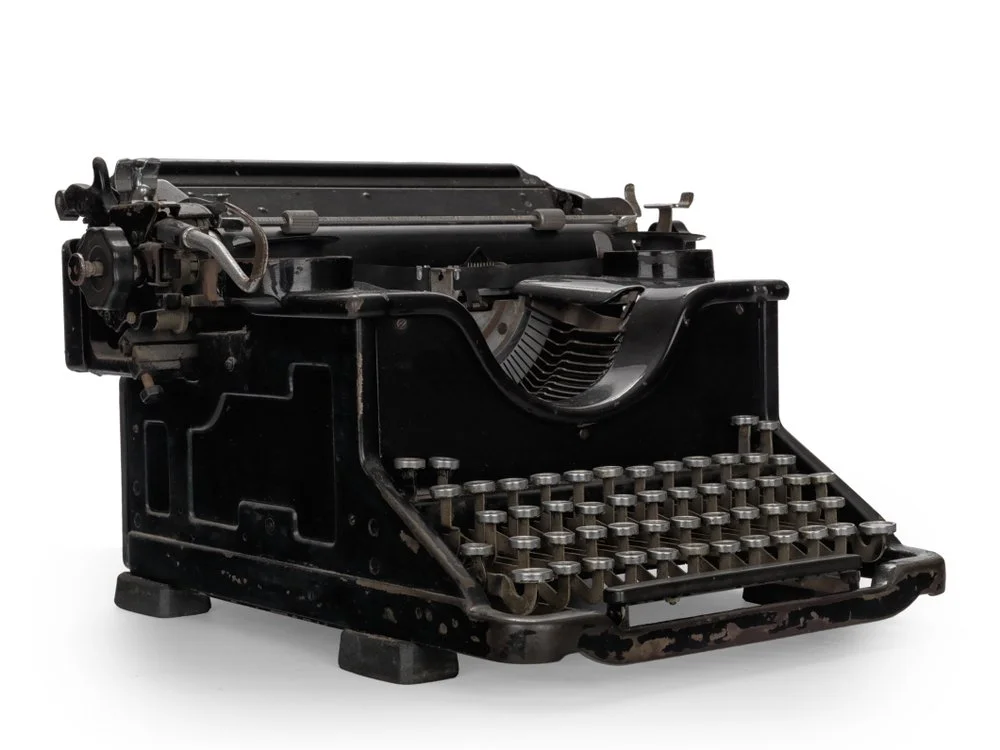
I took an evening course once that proved to be the best investment I ever made. Pictured here is the same model of typewriter that I used for that course. Thank you, Charles Latham Sholes!
Read MoreMy Best Investment Ever
My Best Investment Ever
By Lawrence W. Reed
What was the single best investment you ever made, the one that reaped you the highest return?
Mine involved a mere ten dollars. It continues to pay off, fifty-six years after I made it in 1970. Nothing else even comes close. While most of you are in some way celebrating Valentine’s Day today, I’m thinking of a man born on February 14, 1819, in Mooresburg, Pennsylvania. His name? Christopher Latham Sholes. He invented the modern version of the venerable typewriter with the QWERTY keyboard. The course that taught me how to use it remains to this day my best investment ever.
Back in the late 1960s, Beaver Falls High School (30 miles north of Pittsburgh) offered a typing class, as I suspect most high schools did at the time. I don’t remember why I didn’t sign up for it, but I clearly recall that I was determined to learn how to use the machine. I knew I would soon be in college, where pecking out papers one forefinger at a time just wouldn’t do.
A newspaper ad from the local community college caught my attention. “Learn to Type in Just 10 Weeks.” The price? A whopping $10. That’s equivalent to about $85 in today’s depreciating Federal Reserve notes. I signed up. You had to bring your own typewriter to class, and the heavy clunker I lugged was vintage Calvin Coolidge. The typewriter in the above photo, incidentally, is the very model on which I learned to type.
A year later as a freshman at Grove City College (also in Pennsylvania), I put my new typewriting talents to work, not only typing my own papers properly, but also earning the going rate of 50 cents per page for typing other students’ assignments. The going rate today is nearly ten times that. I charged extra if you wanted a copy for yourself because of the cost of something that young people of these days have never seen—carbon paper. I think I pounded out at least 60 words per minute, stopping only to change the red/black ink ribbon or to slather on a drop of “White-Out” (invented in 1956) and blow-dry it to fix an error. I wish I had kept records (I never did, not even for the IRS), but I know I multiplied that ten-dollar investment into a return of hundreds by the time I graduated, and ultimately into far more than that.
When white correction tape debuted on the market to replace the liquid stuff, I marveled at how technology was improving my typing life.
At some point between college graduation in 1975 and the start of my teaching career at Northwood University in Michigan in 1977, I upgraded to a state-of-the-art typewriter, still Stone Age compared to what we use today. Then in the 1980s I bought an electric one. By the late ‘80s I was cranking out articles and weekly newspaper columns but not until I first wrote out each one with a pen or pencil in long hand on a tablet.
That’s when a friend told me, “You need to get one of these new things called a word processor.”
“What does it do?” I asked.
“You compose in your head as you type and it’s a lot easier to make changes so you won’t need any more ink ribbons and correction tape. No more carbon paper either. The machine will record what you type onto this cool thing called a floppy disk.”
I couldn’t fathom typing something that I had not yet written out, so it took me a while before I bought my first word processor. Laptop computers came next (early ‘80s); I think I bought my first one more than 30 years ago. All these decades and at least 2,000 articles and nine books later, I can’t imagine going back to handwriting first, typing afterwards.
Now, on to the typewriter inventor who shares a birthdate with Valentine’s Day.
As a teenager, Christopher Latham Sholes apprenticed at a print shop in tiny Montour County, Pennsylvania. By the age of 22, he had moved to Wisconsin where he married a local girl in 1841 and began a career as a newspaper publisher and politician. Obviously, the guy had a fascination with words, which served him well in both professions and as an inventor.
He served in both the Wisconsin Senate and in the Wisconsin State Assembly, first as a Democrat, then as a Free Soiler, and finally as a Republican. While in the Senate, he distinguished himself amidst a massive scandal. Most of the legislators, it was revealed, took bribes from railroads but Sholes was one of the few who refused them. His greatest service to humanity, however, derives from the wealth he created as an inventor, not from the wealth he redistributed as a legislator.
Primitive typewriters with keyboards date back to the early 18th Century but left huge room for improvement. Sholes, with the help of a few friends and financiers, created a device that the inventors of those early versions would hardly recognize. And it arranged the letters on the keyboard in especially useful fashion that we still use today, the QWERTY system.
In 1868, Sholes and associates were granted a patent for their invention, labeled by Scientific American as “a literary piano” but which everybody else called a “typewriter.” Its keys, by the way, were made of ebony and ivory. No kidding.
Thank you, capitalism and entrepreneurs (Mr. Sholes in particular), for dragging me into the future! And thanks also to intuition, which prompted me to spend ten dollars on that one-night-a-week, ten-week typing course well over a half-century ago.
I almost forgot: Happy Valentine’s Day.
For additional information, see:
Mr. Typewriter: A Biography of Christopher Latham Sholes by Arthur Toye Foulke
The History of the Typewriter: Being an Illustrated Account of the Origin, Rise and Development of the Writing Machine by George Carl Mares
Leading American Inventors by George Iles
#####
(Lawrence W. Reed is President Emeritus, Humphreys Family Senior Fellow, and Ron Manners Global Ambassador for Liberty at the Foundation for Economic Education in Atlanta, Georgia. His ninth book, Born of Ideas: How Principles, Faith, and Courage Forged America, will appear in April 2026. He blogs at www.lawrencewreed.com.)