
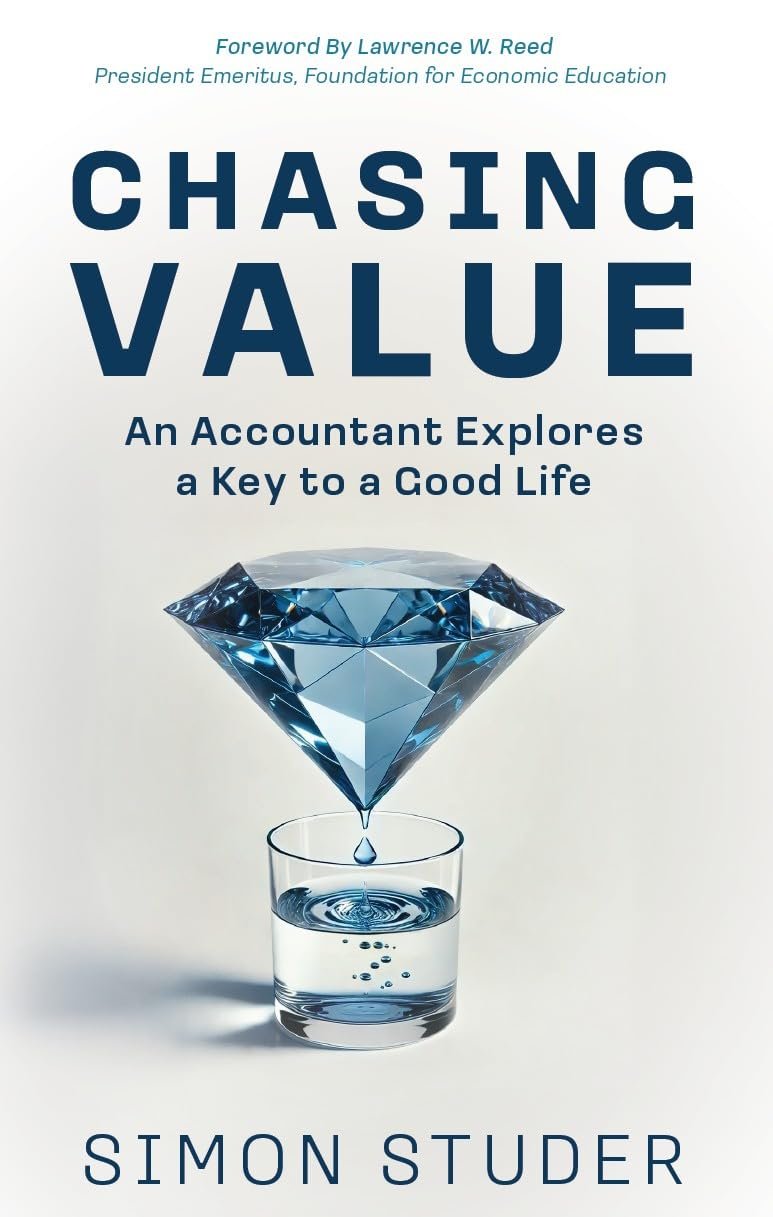
From income inequality to jobs to politics to personal independence, Simon Studer shows how value—subjective, personal value, the only kind there is—makes the world go round. Most readers of this book will never see the world the same way again. And that, you will learn, is a very good thing. A wonderful contribution in the Austrian School tradition.
Read MoreForeword to "Chasing Value" by Simon Studer
Foreword
By Lawrence W. Reed
Every field of science is marked by great discoveries, revelations fraught with lasting implications that transform our understanding of the world.
Two alert telephone company employees experimenting with satellite communications identified what scientists call “cosmic background microwave radiation” a few decades ago. Its uniformity in space confirmed the notion that the Universe originated in a single event, leading to the widely accepted “Big Bang” theory. The implications for physics and astronomy continue to be profound.
In biology, the discovery of DNA and its structure in the 1950s was likewise monumental. Thanks to Scottish physician Henry Faulds, we learned in the 1880s that fingerprints were unique to each human but DNA vaulted that singularity to a new level. A sort of microscopic codebook exists in every human cell, identical to none in any other human.
Economics, one of my primary personal interests, has also produced pivotal moments in our understanding of life. Adam Smith famously revealed that prices, profits and private property act as an “invisible hand” to allocate resources and direct production. A century and a half later, Ludwig von Mises explained that by replacing prices, profits and property with coercive commands, socialism renders itself “unable to calculate,” producing not order and efficiency but instead, a self-indicting “planned chaos.”
An economist’s revelation in the 1870s, especially the vast implications therefrom, are behind this magnificent work from Simon Studer. Chasing Value is the perfect title because it describes what the Austrian economist Carl Menger did in his seminal Principles of Economics in 1871, as well as what Simon does chapter by chapter in this volume.
Classical economics had hit a brick wall by the time Menger wrote Principles. Adam Smith, Karl Marx, and dozens of economists in between mistakenly assumed that value was “objective,” determined by adding up the various costs associated with producing the item in question. Marx placed heavy emphasis on the labor component, suggesting that the more labor that goes into something, the more value it will possess.
Such “cost of production” theories proved woefully inadequate, producing confusion and contradictions. Could an apple pie possibly be worth the same as a mud pie if both required an hour’s labor?
Menger’s revolutionary contribution was to point out that value arises from an item’s utility, that is, its ability to satisfy a human want. An apple pie is more valuable than a mud pie even if it takes the chef an hour longer to make the one from mud. People love to eat apple pies and most think mud pies are a disgusting waste of time. Moreover, the value of the apple pie is not fixed. Rather, it is, like beauty, “in the eye of the beholder.” Value, in other words, is subjective. It’s personal.
So much of what happens in marketplaces was suddenly logical and explainable by virtue of Menger’s subjective value theory. Why is something more valuable to Person A than it is to Person B? Because value is personal. Why do we trade? Because each party to a transaction values what he gets more than he values what he trades away.
It all seems so obvious now, but 150 years ago, scholars were vexed by value and where it came from. Today, subjective value theory is so universally assumed that many people know nothing of its origins and underestimate the revealing powers of its application.
Simon Studer has taken on an important task here. He has grabbed onto a Mengerian insight, dusted it off, and polished it so it shines again as a beacon for understanding. And he does this so well, so thoroughly, and with such accessible articulation that it can never again be taken for granted. The reader will be amazed at the countless ways he deploys it to explode misconceptions and help us better comprehend the world in which we live.
From income inequality to jobs to politics to personal independence, Simon Studer shows how value—subjective, personal value, the only kind there is—makes the world go round. Most readers of this book will never see the world the same way again. And that, you will learn, is a very good thing.
Lawrence W. Reed
President Emeritus, Foundation for Economic Education
www.fee.org