
Only socialists can look at Poland and Venezuela and arrive at the wrong conclusion. For everybody else, which system works and which does not is as certain as where the sun rises and where it sets. Spanish version: https://tinyurl.com/yt44u7px.
Read MoreThe Story Told by Poland and Venezuela
The Story Told by Poland and Venezuela
By Lawrence W. Reed
The sun rises in the east and sets in the west, and it’s been that way far longer than any of us can remember. No evidence exists of a single day when the sun came up in the west and set in the east. None. It’s one of those reliable truths that everybody learns once, nobody ever forgets, and no one in his right mind would dispute.
The physical sciences—the realm of non-living matter encompassed by disciplines such as astronomy, physics, and chemistry—often produce certainties like that of the sun’s daily perambulations. They are evidence of an ordered universe where immutable mathematics, empirical observations, and objective analysis rule. By contrast, social sciences—including economics, history, political science, anthropology and more—are influenced by human behavior, personal choices and subjective opinions. Even when certainties do exist and ought to be recognized, they are often overruled by whims, fancies, dreams, and yes, even stupidity.
The focus of my professional life is history and economics, where a very big question is this: Which system is more conducive to human flourishing, capitalism or socialism? If you want people fifty years from now to live better, longer and happier lives, which of those two systems would you advise them to embrace? For the sake of argument and space limitations, I’m going to assume here that the reader knows the differences between the two but if you need a refresher, see the links at the bottom of this article.
To me, the verdict couldn’t be clearer. Capitalism wins hands down. By encouraging work, innovation, entrepreneurship, and customer service, it prompts creative people to produce the wealth that allows us to live better, longer, and happier lives. Socialism, on the other hand, is not concerned about wealth creation; it wallows in redistribution and consumption, fueled often by envy and revenge. Socialists are most animated when they use political power to punish somebody (like the “rich”) and they are typically less interested in helping somebody. Studies have repeatedly shown that socialists are far more generous with other people’s money than they are with their own.
From history we learn that socialism is the economics equivalent of the Hindenburg dirigible—puffed up with pomp and promise before crashing and burning. It doesn’t seem to matter whether it manifests itself in the form of communal utopias of the Robert Owen variety or the iron-fisted prison societies of the Soviet type. They all eventually go down in flames. Then rather than learn from the experience, most socialists figure that if they just pull an all-nighter, they can get it right the next time.
That’s enough background noise. What I really want the reader to know is the revealing story of two nations from recent times. In broad terms, one chose socialism, the other chose capitalism. The outcomes couldn’t be more starkly instructive. I could have selected West Germany and East Germany. Or South Korea and North Korea. Or Hong Kong and mainland China. Or the Cayman Islands and Cuba. Comparing those usual suspects would yield the same verdict. But instead, allow me to contrast Poland and Venezuela.
The following illustration tracks GDP per capita in both Poland and Venezuela over nearly a century. In 1931, the two countries were virtually the same by this measure. For the next 60 years, Venezuela’s mixed economy outperformed Poland’s heavily socialized one.
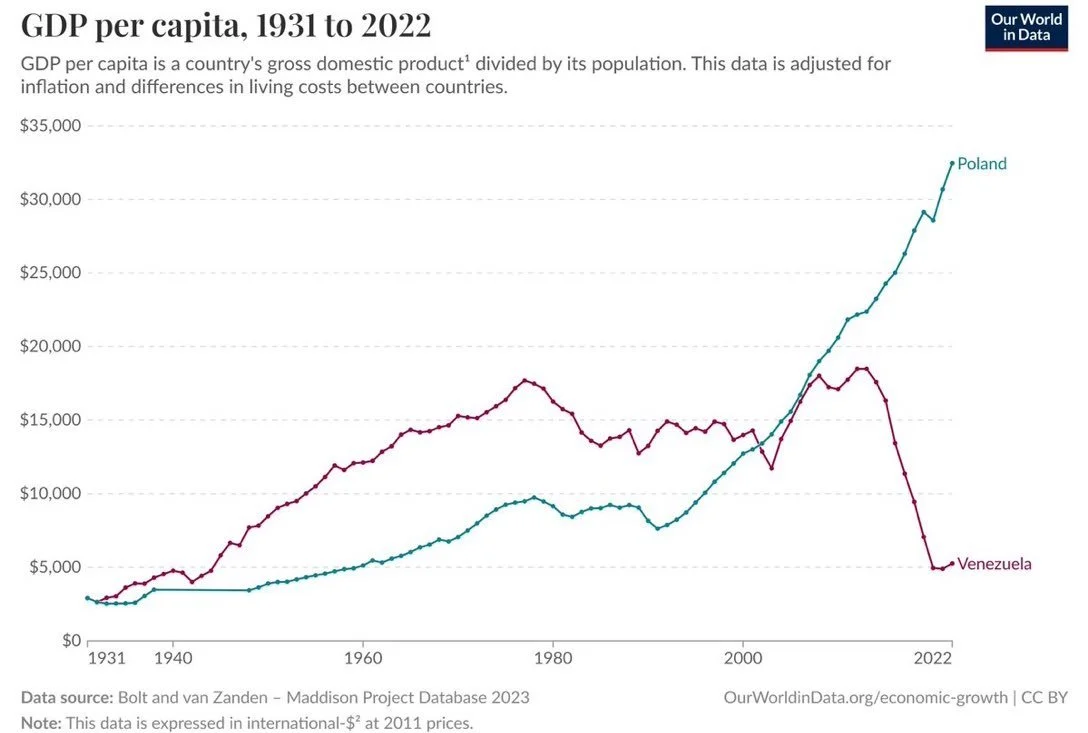
Then in 1989, a liberated Poland turned decisively in a capitalist direction—prices were freed; regulations, taxes, and bureaucracy were slashed; private property, investment both domestic and foreign were encouraged; entrepreneurship was unleashed; and state enterprises were privatized. The famous Balcerowicz Plan transformed a decrepit, socialist disaster into a dynamic capitalist success.
In the 1970s and 1980s, Venezuela began throttling the capitalist elements of its mixed economy. Certain industries were nationalized. Then in 1998, Hugo Chavez came to power promising a full-blown, unadulterated socialist program. “Power to the people!” he declared, as he socialized just about everything. From prices to the press, the government would control. Hollywood leftists proclaimed the dawn of a new society where, for the first time, socialism would work.
Look at that illustration again. Poland’s per capita GDP today is between six and seven times higher than Venezuela’s.
Economic freedom (capitalism) makes all the difference in the world. Poland’s economy in 2025 was ranked the 40th freest on the planet, whereas Venezuela’s rated among the least free, at Number 174. Only ten countries on Earth ranked as more socialist than Venezuela.
Georank.org documents other measures by which the systems of these two countries differ:
In Poland, annual personal income after taxes is more than four times higher than it is in Venezuela.
The market capitalization of Polish companies stands at $197 billion. Venezuela’s domestic companies, by contrast, are worth a measly $3.98 billion. That’s barely 2 percent of Poland’s, though the populations of the two countries are only a few million apart.
Socialists decry income inequality, assuming falsely that an economy is a zero-sum game. But the gap between rich and poor is higher in socialist Venezuela, where the richest 10 percent claim 33.2 percent of all income, than it is in Poland, where the comparable number is 22.9 percent.
Socialists will take comfort in the fact that Venezuela is home to only a single billionaire (probably Nicholas Maduro pre-January 2026 or one of his friends), while Poland boasts ten.
Life expectancy in Poland (at 79.2) is more than six years higher than Venezuela’s 73.
Inflation is one of the very few measures in which Venezuela’s number is higher—a whopping 618 percent vs Poland’s 2.2 percent. Another is national debt: Venezuela’s is 216 percent of GDP, while Poland’s is merely 64 percent (compared to the U.S. figure of 124 percent).
Tourism tells a similar tale. In the most recent year for which figures are available, 429,000 foreigners visited the workers’ paradise of Chavez/Maduro. In the same year, an astonishing 88.5 million visited Poland.
The natives are restless too. Since 1998, about eight million Venezuelans fled their country, fueling one of the largest diasporas since World War II. Nobody speaks of “Polish refugees” today. In fact, European countries like Germany fret that they increasingly cannot keep skilled Poles, who are emigrating back to Poland for opportunities in its prosperous economy.
Only socialists can look at Poland and Venezuela and arrive at the wrong conclusion. For everybody else, which system works and which does not is as certain as where the sun rises and where it sets.
For additional information, see:
Poland and Venezuela Compared by Georank.org
Poland May Need a New Balcerowicz Plan: An Interview with Lawrence Reed
How Venezuelans Can Recover From the Sickness of Socialism by Lawrence W. Reed
Socialism: Science or Cyanide? by Lawrence W. Reed
Where are the Omelets? by Lawrence W. Reed
Six Ways Socialism is Anti-Social by Lawrence W. Reed
Was Marx a Peacenik? Give Me a Break! by Lawrence W. Reed
Socialism: Force or Fantasy? by Lawrence W. Reed
The Dark Side of Paradise: America’s Experiments in Utopian Socialism by Lawrence W. Reed
The Good Counsel of Mrs. Marx by Lawrence W. Reed
Ludwig Erhard: Architect of a Miracle by Lawrence W. Reed
A Tribute to the Polish People by Lawrence W. Reed