
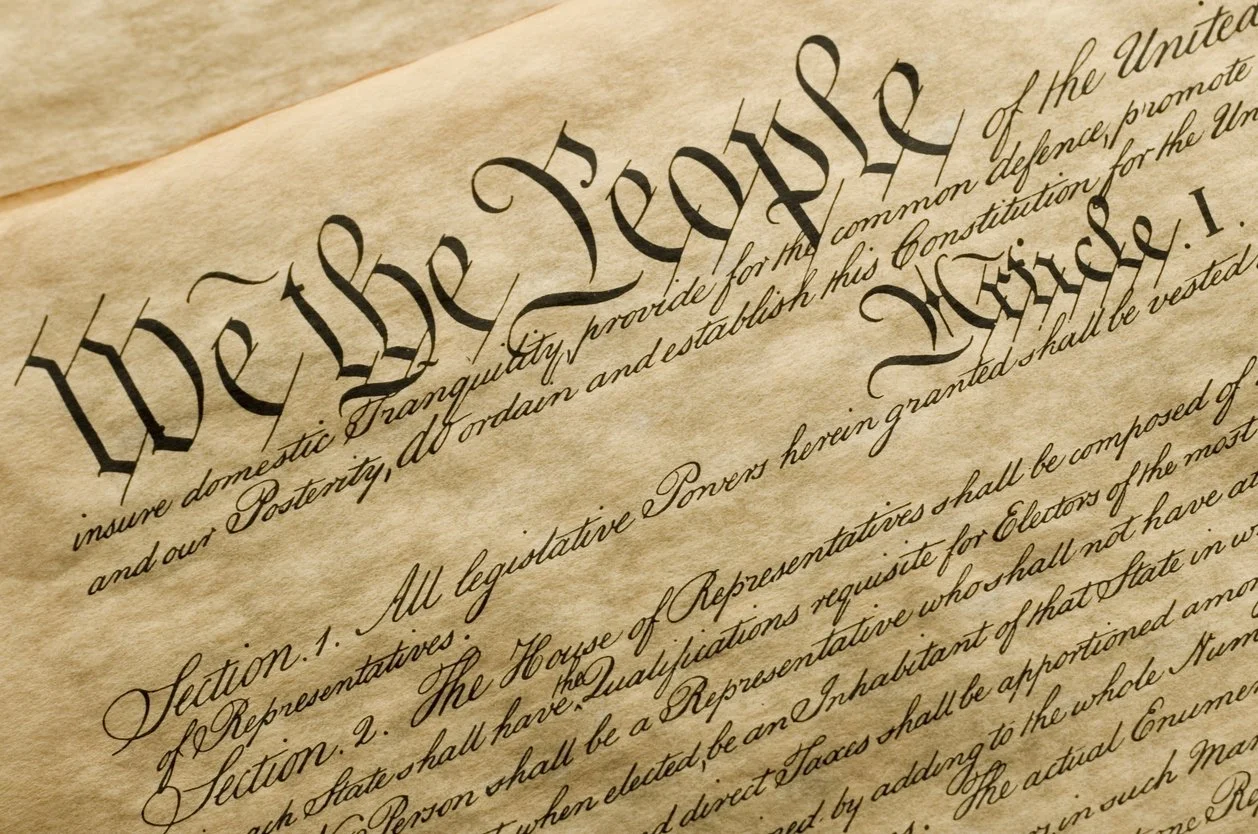
What is the main source of our big government problem today—a flawed document or flawed individuals who have allowed its protections to wither?
Read MoreOn Constitution Day, Celebrate the Anti-Federalists
Celebrate the Anti-Federalists
By Lawrence W. Reed
On September 17, 1787, delegates to the Constitutional Convention in Philadelphia signed the Constitution they had spent the summer hammering out, paving the way for its ratification nine months later by the required number of states. Since President Dwight Eisenhower signed the bill creating Constitution Day in 1957, Americans have commemorated that original signing every year on September 17.
This year, I note the day by paying tribute to the Anti-Federalists who generally opposed the Constitution.
In two previous essays, Reading the Articles of Confederation and Defending the Constitution, I argued that “the crisis of the 1780s” necessitated dramatic changes to America’s central government. After spirited debate in every state, compromises resolved the crisis in the form of the new Constitution. On one side of that debate were the Federalists, who favored a strong central government, and on the other side were the Anti-Federalists, who preferred to keep power in the hands of sovereign states.
At least that’s what most of us learned in high school—strong government vs weak government. In a generic contest between strength and weakness, most people would instinctively choose strength, so the Anti-Federalists in most classrooms are briefly acknowledged and then dismissed. They deserve far better. Their principled positions considerably improved the final document.
The leading Anti-Federalists included Patrick Henry, George Mason, Mercy Otis Warren, Samuel Adams, Richard Henry Lee, Roger Sherman, Elbridge Gerry, Melancton Smith, and Luther Martin. They were not of one mind on everything, and in the end, some Anti-Federalists supported the Constitution after significant compromises with the Federalists were achieved. Concentrated power, they all agreed, was liberty’s lethal foe. Today, many Americans hardly think twice about conceding liberty to power if some short-term benefit is involved, but the Anti-Federalists knew from history that if you give any government an inch, it will take a mile.
It is to the Anti-Federalists that we owe gratitude for the first ten amendments we know as the Bill of Rights. At their insistence, the critical protections embodied in those amendments were adopted.
Without the Bill of Rights, the Constitution itself would probably not have been accepted. The ten amendments guarantee freedoms of religion, speech, the press, peaceful assembly and petition; the rights of the people to keep and bear arms, and to hold private property; rights to fair treatment for people accused of crimes, protection from unreasonable search and seizure and self-incrimination; and rights to a speedy and impartial jury trial and representation by counsel.
The First Amendment is a masterpiece of Anti-Federalist sentiment, one we all should read and re-read, and be eternally grateful for:
Congress shall make no law respecting an establishment of religion, or prohibiting the free exercise thereof; or abridging the freedom of speech, or of the press; or the right of the people peaceably to assemble, and to petition the Government for a redress of grievances.
Are you happy that, unlike much of Europe, we have no “state church” in America, that freedoms of speech and press are expressly enshrined in the supreme law of our land? Thank the Anti-Federalists. And on those occasions when the federal government has overstepped its boundaries in these areas, blame not the document but the culprits in government who do the overstepping and the people who vote for them.
Are you glad that not all the guns in the country are in the hands of the government, that individuals can (with some conditions) “keep and bear arms” for sport or self-defense? Thank the Anti-Federalists for the Second Amendment.
The Ninth Amendment declares that rights enumerated in the Constitution “shall not be construed to deny or disparage others retained by the people.” It arose because of the concern of the Anti-Federalists that because a certain right was not listed in the Bill of Rights, the power-hungry would be tempted to assert that it does not exist.
The Tenth Amendment affirms our system of “federalism.” It states that “the powers not delegated to the United States by the Constitution, nor prohibited by it to the states, are reserved to the states respectively, or to the people.” In other words, if a question arises about what the federal government can or can’t do, the automatic default is not a green light for Washington.
The Bill of Rights is fundamental and foundational, and about as bedrock as it gets. In fewer than 500 words, many of our most cherished liberties are expressed as rights to be jealously protected. It’s a roster of instructions to government to keep out of where it doesn’t belong.
The Anti-Federalist message shows up in many other parts of the Constitution. Wherever state and local sovereignty is protected, wherever lines of demarcation between state and federal power appear, wherever checks and balances and separation of powers are plainly expressed, thanks are due, in part or in whole, to the Anti-Federalists. Their influence on these matters nudged the document toward safeguarding liberty and away from giving the federal government power carte blanche.
I am painfully aware that our central government thwarts the Constitution all the time these days. Lovers of liberty must constantly challenge its overreach. Even many Federalists of the 1780s and 1790s would be aghast at the behemoth the federal government has become. In their fundamental distrust of power, the Anti-Federalists were absolutely on the mark.
The question is, what is the main source of our big government problem today—a flawed document or flawed individuals who have allowed its protections to wither? After you answer that one, I have another one for you: If the Constitution with its Bill of Rights had been rejected instead of adopted, would America have become a strong and free nation anyway?
Ben Franklin was right when he said the Constitution gave Americans a republic but subsequent generations and their attitudes would decide if we could “keep it.” That the original spirit and letter of the Constitution are worth keeping is a tribute to the Anti-Federalists as much as it is to anyone else.
For additional information, see:
In Defense of the Constitution by Lawrence W. Reed
Reading the Articles of Confederation by Lawrence W. Reed
The Anti-Federalist: Writings the Opponents of the Constitution, Herbert J. Storing, editor
The Anti-Federalists and Early American Political Thought by Christopher M. Duncan
The Anti-Federalists Were Right?: Martin, Mason, Gerry, Cato, and the Pennsylvania Dissenters: The Case Against Ratification by Michael Boldin and Michael Maharrey
The Creation of the American Republic: 1776-1787 by Gordon S. Wood
Power and Liberty: Constitutionalism in the American Revolution by Gordon S. Wood
We Have Not a Government: The Articles of Confederation and the Road to the Constitution by George William Van Cleave