
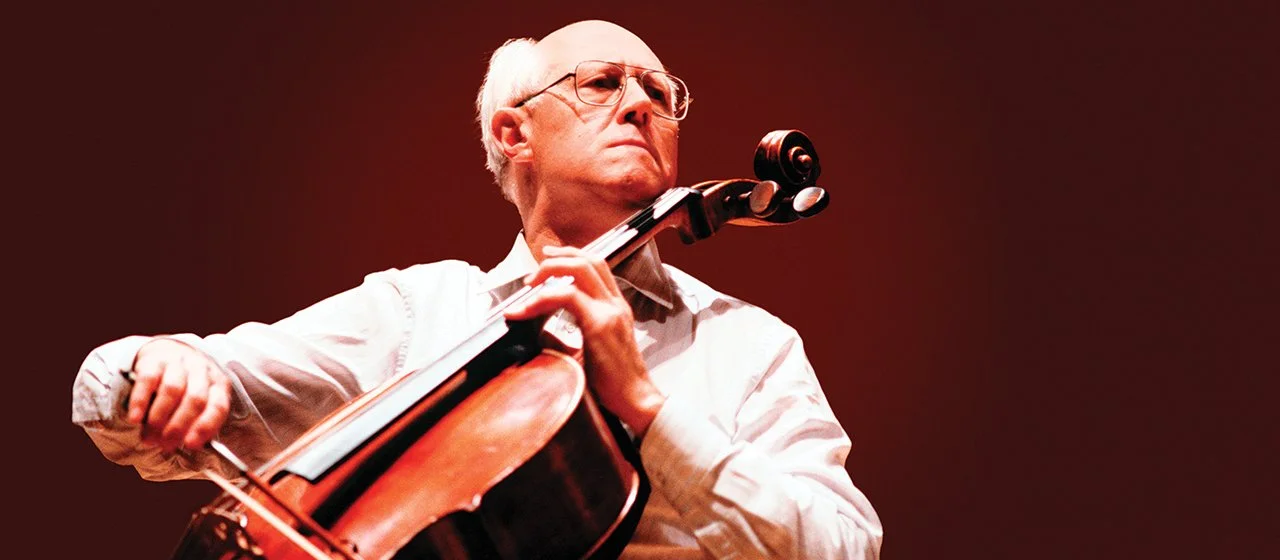
One of the 20th Century’s giants of both music and freedom.
Read MoreRemembering Rostropovich
Remembering Rostropovich
By Lawrence W. Reed
A year from now—on March 27, 2027—the musical world will mark the centennial of the birth of a remarkable virtuoso. In the final decades of his 80-year life, he could get a standing ovation simply by walking onto a stage, before he played a single note. He deserves to be celebrated for his singular talents as a premiere cellist, but also for his courageous stance against political tyranny.
Mstislav Rostropovich was born of Russian parents in Baku, Azerbaijan, on March 27, 1927, when the country struggled as one of 15 Soviet Republics under communist domination from Moscow. Raised in a family whose musical talents spanned several generations, he learned piano first, followed by the instrument for which he would gain global fame, the cello.
My first and clearest memory of Rostropovich dates to television news reports in November 1989. The infamous Berlin Wall was crumbling (and Soviet socialism along with it), smashed into rubble by freedom-loving Germans with pickaxes and sledgehammers. In the middle of those glorious hours, the 62-year-old Rostropovich showed up with his cello and a chair. As the Wall disintegrated a few inches behind him, he played one of Bach’s cello suites. It was a joyful celebration that those present, and the millions more around the globe who watched on TV, surely never forgot. It was vintage Rostropovich.
In the decades after his first concert in 1942, he came to be regarded as among the finest cellists, the most distinguished conductors, and the greatest teachers of music in the modern world. He accumulated awards, honors and accolades too numerous to count.
He made his “official” debut as an anti-Soviet dissident in 1948 at the age of 21. When his teacher, the great composer Dmitri Shostakovich, was fired from posts in Leningrad and Moscow for suspected anti-communist sentiments, Rostropovich resigned from the prestigious Moscow Conservatory. Shostakovich famously worked his anti-Stalin views into his music, right under the dictator’s nose, and Rostropovich later helped smuggle his teacher’s compositions out of the country.
At age 41, Rostropovich was in London to perform for the USSR State Symphony Orchestra. It was the very day of the Soviet-led Warsaw Pact invasion of Czechoslovakia. To express support for the Czechs, he brazenly held aloft a copy of Czech composer Antonin Dvorak’s Cello Concerto in B-minor. The audience instantly perceived the gesture as an act of defiance and cheered wildly.
Perhaps the Russian dissident best known in the West during the Cold War days was Aleksandr Solzhenitsyn, author of the blockbuster exposé, The Gulag Archipelago. (See my “Remembering Solzhenitsyn” piece.) After the secret police of the KGB nearly assassinated Solzhenitsyn in 1971, it was the writer’s friend Mstislav Rostropovich who sheltered and supported him at huge risk to himself.
The great cellist spoke out repeatedly in favor of artistic freedom and against the regime’s ugly, self-serving censorship. If Rostropovich had not gotten out of the Soviet Union in 1974, he might well have been dispatched to one of the prisons in the Gulag system that his friend Solzhenitsyn had written about.
After Rostropovich settled in the United States, he was stripped of his Soviet citizenship and banned from ever performing in his home country again. He never returned until 1990, as Soviet communism was finally breathing its last.
For 17 years (1977 to 1994), he had served as music director and conductor of America’s National Symphony Orchestra in Washington, D.C. While awarding him the Presidential Medal of Freedom in 1987, President Reagan remarked:
He once jokingly asked his mother why she had carried him longer than the usual 9 months. “Slava,” she answered, “to give you such beautiful hands.” Performing, teaching, and conducting, the beautiful hands of Mstislav Rostropovich have shared with millions his passion for music, especially the music of the homeland he has never ceased to love. He is a virtuoso not only of music but of heart and mind, as well.
Rostropovich died on April 27, 2007, at age 80 and was buried in Moscow’s Novodevichy Cemetery, the same graveyard as his teacher Shostakovich.
For his musical talents and his moral courage, Mstislav Rostropovich should be remembered as one of the giants of the 20th Century. When he posthumously turns 100 on March 27, 2027, I intend to once again watch him play the cello suites by Bach he loved so much.
For additional information, see:
Russian Maestro Rostropovich Dies—BBC News obituary
Rostropovich conducts Tchaikovsky’s Romeo & Juliet (video)
(Lawrence W. Reed is President Emeritus, Humphreys Family Senior Fellow, and Ron Manners Global Ambassador for Liberty at the Foundation for Economic Education in Atlanta, Georgia. His ninth book, Born of Ideas: How Principles, Faith, and Courage Forged America, will appear in May 2026.)