
On July 2, 1776, the same day the Congress approved a resolution to separate from Britain, he declared to his congressional colleagues, “The country is not only ripe for the measure, but in danger of rotting for the want of it.”
Read MoreFor This Founder, A Statue is the Least That We Can Do
For This Founder, A Statue is the Least We Can Do
By Lawrence W. Reed
To the country’s everlasting benefit, America’s founding generation proved to be an uncommonly principled, God-fearing, courageous and liberty-loving one. The men and women who fought and won World War II comprised a great generation to be sure, but “the greatest” is a title that belongs to Americans of the founding era.
Almost all Americans know the most famous names, and they might even be able to tell you something about them—Patrick Henry, George Washington, John and Abigail Adams, Benjamin Franklin, Thomas Jefferson, James Madison, Benjamin Rush, John Hancock, and more. One name largely forgotten but deserving of great appreciation is the subject of this essay.
He was born in a small village 25 miles east of Edinburgh in Scotland, where he established himself as an eloquent Presbyterian preacher. In August 1768 at the age of 45, he and his family emigrated to America.
From his arrival in 1768 until his death 26 years later, this man held the post of President of the College of New Jersey (later known as Princeton). The people who studied in his literature, history or theology classes there read like a “Who’s Who?” of revolutionary patriots, lawmakers and future presidents. James Madison, the father of the Constitution, was personally and profoundly affected by his classes.
His students included 37 future judges (three of whom became Supreme Court justices), 12 state governors, 10 cabinet officers, 9 Constitutional Convention delegates, 28 U.S. Senators, 29 U.S. House representatives, 56 state legislators, 6 signers of the Declaration of Independence, 31 Revolutionary Army officers, about a hundred ministers, and 13 college presidents.
He was the only clergyman and the only college president to sign the Declaration of Independence.
His name was John Witherspoon (1723-1794), and I’m proud to note that, though I am not a direct descendant of John, a genealogist confirmed for me that Witherspoon blood flows in my veins. My Witherspoon ancestors all hailed from the same corner of southern Scotland as he did.
John Witherspoon exemplified Scotland’s immense influence on early American history. Of the 56 signers of the Declaration, 21 (including him) were Scottish or of Scots-Irish descent. That’s a stunning 38 percent. It’s a good bet that they all were well aware of an earlier document issued by Scottish rebels battling England in the year 1320, in which the signers declared, “It is not for honors or glory or wealth that we fight, but for freedom alone, which no good man gives up except with his life.”
Editor and publisher Roger Kimball notes that Witherspoon “was a potent rhetorician and controversialist, an important ally for those whose allegiance to conservative religious principles was fired by a commitment to individual liberty and freedom of conscience.”
Back in Scotland before he turned 30, Witherspoon weighed into a major Presbyterian church dispute known as the Inverkeithing Case. In 1752, a minister in the parish of Fife died, prompting the local presbytery to install a new one according to church law. The congregation, however, strongly opposed the appointment and preferred to name their own pastor. Witherspoon wrote an essay that satirized his church’s leadership and strongly asserted the rights of the congregation to religious liberty and self-rule—essentially the same arguments he would muster on behalf of the American colonies a generation later.
As Princeton’s sixth president starting in 1768, Witherspoon faced huge challenges at the college. The school was deep in debt. Its library and its faculty were in bad shape. He fundraised effectively to reduce the debt, donated hundreds of books from his own collection, and began hiring eminent scholars that the best students wanted to learn from. He saved the college, and, at great personal sacrifice in time and resources, he would save it again when the invading British damaged much of it in 1777. Princeton’s early reputation as an intellectual powerhouse is due largely to his influence and direction.
Witherspoon never doubted the case for American independence. From his earliest days here, he expressed sentiments for separation. He grounded his reasoning in the natural rights granted to men by their Creator, not by any earthly government. He was among the first to join the New Jersey Committee of Correspondence to resist British authority and to unify the colonies against it. He was elected as a delegate to the Second Continental Congress in 1776, where he served until November 1784.
In his magnificent tome on the Great Awakening, Baylor University historian Thomas S. Kidd claims emphatically that “no minister played as prominent a role in the political rebellion.” Witherspoon contributed “a Scottish Presbyterian strain to American republicanism and “believed that only sincere Christianity could sustain the purity of the republic.” Kidd cites this passage from the great preacher’s widely published sermon of May 17, 1776, The Dominion of Providence over the Passions of Men:
A general profligacy and corruption of manners [behavior] make a people ripe for destruction, [but] when the manners of a nation are pure, when true religion and internal principles maintain their vigor, the attempts of the most powerful enemies to suppress them are commonly baffled and disappointed.
That very sermon ranks as one of the most important in American history. One commentary notes that it “is widely regarded as helping to prepare the way for the decisive move for independence later that summer.” Witherspoon climaxed it with this passionate closing:
I beseech you to make a wise improvement of the present threatening aspect of public affairs, and to remember that your duty to God, to your country, to your families, and to yourselves, is the same…[I]t is in the man of piety and inward principle that we may expect to find the uncorrupted patriot, the useful citizen, and the invincible soldier. God grant that in America, true religion and civil liberty may be inseparable, and that the unjust attempts to destroy the one, may in the issue tend to the support and establishment of both.
When some holdouts in the Second Continental Congress suggested that independence from Britain was premature, Witherspoon insisted otherwise. On July 2, 1776, the same day the Congress approved a resolution to separate from Britain, he declared to his congressional colleagues, “The country is not only ripe for the measure, but in danger of rotting for the want of it.”
During the War for Independence, Witherspoon’s keen mind exhibited a grasp of sound economics. He eloquently opposed the printing of fiat paper money and the adoption of price controls. In a brilliant essay on these matters, Eric W. Matson says that he “conveys a sophisticated understanding of the market process.” Matson quotes the great preacher’s admonition to Congress: “It is beyond the power of despotic princes to regulate the price of goods.”
Kevin DeYoung, at ClearlyReformed.org, provides us with a very good summation of Witherspoon’s influence as “one of our most quintessential, if often forgotten, founders.” DeYoung states,
He was well respected and often sought out for advice by the likes of George Washington, John Adams, Thomas Jefferson, Alexander Hamilton, and Benjamin Franklin. James Madison stayed on an extra year at Princeton to sit under Witherspoon’s personal instruction. Besides the Declaration, Witherspoon also signed the Articles of Confederation, helped New Jersey ratify the Constitution, served in the state legislature, and participated in 126 committees during his six years in the Continental Congress. At various points, he served on the committee of finances, the committee to confer with George Washington on the military crisis and the procurement of supplies, the secret committee charged with executing the war effort, and on the all-important Board of War. Having learned French at a young age, Witherspoon also translated for French dignitaries visiting America. Furthermore, he personally taught a generation of educators, legislators, and statesmen in the new republic.
Yet another feather in Witherspoon’s hat came in December 1787. As an elected member of New Jersey’s convention to consider adopting the Constitution, he voted to make the state the third to ratify the document.
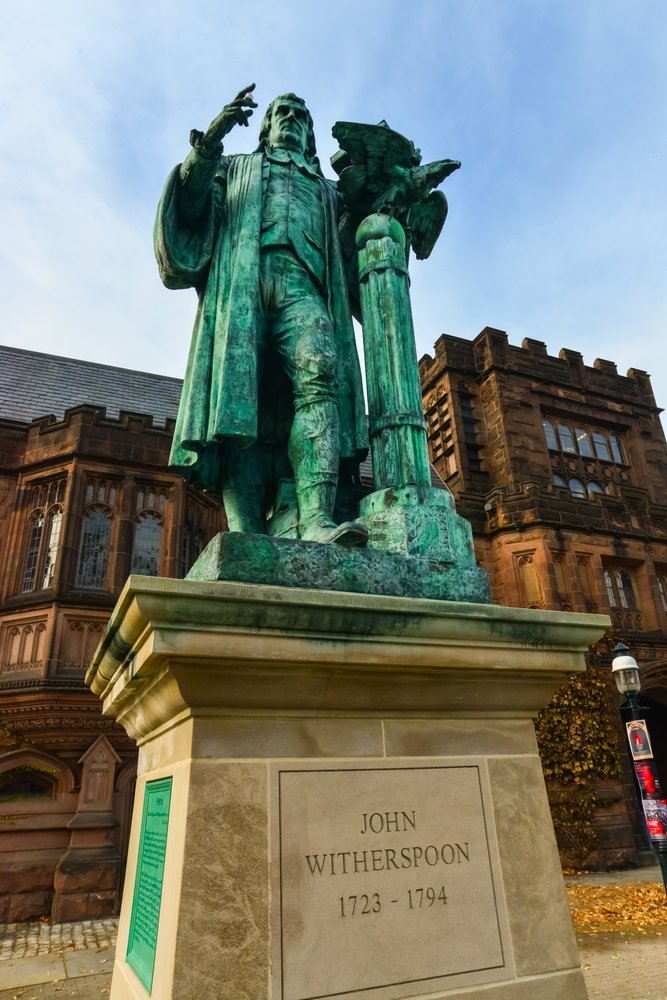
An impressive statue of Witherspoon adorns Firestone Plaza on the Princeton campus in New Jersey. Four years ago, a group of students and faculty petitioned college administrators to dismantle it because Witherspoon owned two slaves for a total of seven years. So far, the attempt to erase a great hero has failed and the statue still stands. For an account of Witherspoon’s complicated relationship with slavery that is fairer and more informed than that of virtue-signaling radicals, see Kevin DeYoung’s essays, John Witherspoon and Slavery and A Fuller Measure of Witherspoon on Slavery.
Witherspoon died at his country home, Tusculum, on November 15, 1794, at the age of 71. America must never forget the indelible mark he left behind.
Sources and Additional Information:
John Witherspoon and the Founding of the American Republic by Jeffry H. Morrison
The Great Awakening: The Roots of Evangelical Christianity in Colonial America by Thomas S. Kidd
The Piety of John Witherspoon: Pew, Pulpit, and Public Forum by L. Gordon Tait
John Witherspoon’s American Revolution by Gideon Mailer
John Witherspoon and Slavery by Kevin DeYoung at Clearly Reformed.org
John Witherspoon (Prager University video)
The Dominion of Providence over the Passions of Men by John Witherspoon
The Recurrent Evil of Price Controls: John Witherspoon’s 1778 Letter to George Washington by Erik W. Matson
A Fuller Measure of Witherspoon on Slavery by Kevin DeYoung
John Witherspoon in Historical Context (video) by Kevin DeYoung
Inconvenient Truths About Slavery by Lawrence W. Reed
America’s Forgotten Founding Father: John Witherspoon by Roger Kimball
#####
(Lawrence W. Reed is President Emeritus, Humphreys Family Senior Fellow, and Ron Manners Global Ambassador for Liberty at the Foundation for Economic Education in Atlanta, Georgia. His forthcoming book, Born of Ideas: How Principles, Faith, and Courage Forged America, is available for pre-order now on Amazon.)