
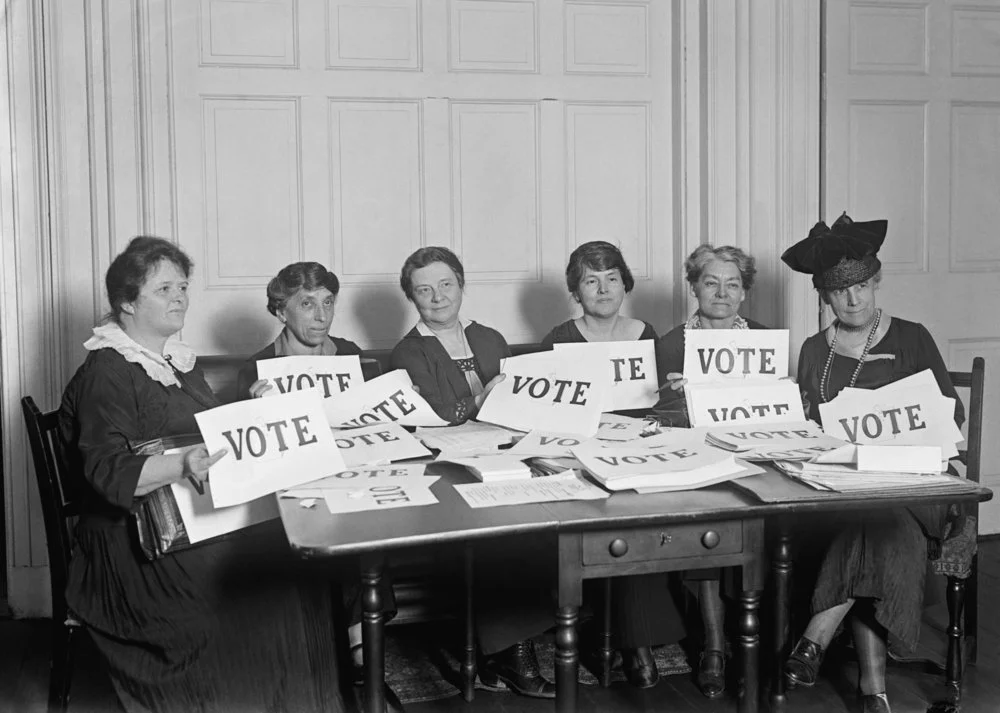
What were the reasons why America’s founders did not buy into women’s suffrage nearly 250 years ago? You might not agree with them, but you can at least try to understand them.
Read MoreWomen and the Founders
Women and the Founders
By Lawrence W. Reed
Some critics of America’s founders point out that the Constitution, drafted in 1787, failed to grant women the right to vote.
My question for those critics is this: In how many other nations of the world in 1787 could women legally cast a ballot?
The answer may surprise many readers: ZERO.
The first country to recognize women’s suffrage was New Zealand, and that wasn’t until 1893. By then, women had already been fully enfranchised in Wyoming and Utah for more than 20 years. When America’s 19th Amendment gave women the right to vote nationwide in 1920, women were already voting in fifteen states of the U.S., but in only about 20 countries around the world.
The old Soviet Union granted the vote to women two years before America did. Saudi Arabia got around to it in 2011. Of course, in both places nobody’s vote ever counted for much because the choices were sharply limited and election outcomes were pre-determined.
The women’s suffrage movement in America began in the 1840s, a half-century before New Zealand’s milestone, but females were never unanimous on the question; indeed, a thriving anti-suffrage movement among women bedeviled their female pro-vote opponents right through the 1920s. If you think all men were opposed to women voting, or that all women were in favor of it, or that all men against women’s suffrage were misogynist women-haters, you’re indefensibly simplistic and inexcusably inaccurate.
The perspective of the female anti-suffragists seems anachronistic today but as historian Susan Goodier explains,
Their reasons included the points that most women did not want the burden of the vote, that women were already very busy with homes and families, that suffrage would add to women’s duties in adverse ways, that women’s suffrage would add an unwelcome element to an already encumbered government, and that many women were not capable of making astute political decisions.
Let’s return to 1787.
What were the reasons why America’s founders did not buy into women’s suffrage nearly 250 years ago? You might not agree with them, but you can at least try to understand them. Do not commit the sin of presentism by dismissing people of the past for falling short of the conventions of today.
The late Gordon S. Wood, who sadly passed away at 92 only a month ago, was a phenomenal scholar of early America. In his book, The Radicalism of the American Revolution, he explained the suffrage sentiments of the founders this way:
A republic presumed, as the Virginia declaration of rights put it, that men in the new republic would be “equally free and independent,” and property would make them so. Property in a republic was still conceived of traditionally—in proprietary terms—not as a means of personal profit or aggrandizement but rather as a source of personal authority or independence. It was regarded not merely as a material possession but also as an attribute of a man’s personality that defined him and protected him from outside pressure. A carpenter’s skill, for example, was his property. Jefferson feared the rabble of the cities precisely because they were without property and were thus dependent.
All dependents without property, such as women and young men, could be denied the vote because, as a convention of Essex County, Massachusetts, declared in 1778, they were “so situated as to have no wills of their own.” Jefferson was so keen on this equation of property with citizenship that he proposed in 1776 that the new state of Virginia grant fifty acres of land to every man that did not have that many. Without having property and a will of his own—without having independence—a man could have no public spirit; and there could be no republic. For, as Jefferson put it, “dependence begets subservience and venality, suffocates the germ of virtue, and prepares fit tools for the designs of ambition.”
For good or ill, women in the late 18th century, as in centuries prior, were largely dependent upon the men of society (their husbands especially). The founders believed that a republic required voters who would not be unduly influenced by other voters because of a dependency relationship.
Times have changed since then. American women in 2026 are both independent and independently minded to a far greater extent than those of 1787. Indeed, it’s reasonable to assume that many of the founders might acknowledge that fact and support women’s suffrage now. They would likely add, “That’s why we gave you an amendment process, so you could change the Constitution as you saw the need.”
Yes, we’ve come a long way on the dependency question in the last two centuries. But I would argue that in some respects, we’ve moved in some wrong directions. One of the two major political parties today sees “dependency” as a virtue, especially if it means they get to buy your vote with other people’s money. See The Democratic Party’s Propaganda: A Ruthless Engine of Dependency That Crushes Self-Reliance.
Here’s another perspective on the social attitudes of yesteryear:
The most powerful barrier to women’s suffrage was not a specific law but a belief system. Throughout the 18th and 19th centuries, American society operated on the assumption that men and women occupied fundamentally different worlds. Men belonged in public life, which meant politics, commerce, and law. Women belonged in the home, responsible for raising children, managing households, and serving as moral anchors for their families. Historians have called this framework the “Cult of True Womanhood,” and it rested on four supposed virtues: piety, purity, domesticity, and submission.
This was not presented as an arbitrary social arrangement. It was treated as natural law. Women were characterized as too emotional, too delicate, and too morally elevated for the rough business of politics. The irony was that these qualities were framed as compliments rather than insults. Supporters of separate spheres argued that women wielded a different kind of influence, one that operated through moral example and private counsel to husbands and sons. An 1884 anti-suffrage petition put it plainly: a woman’s best contribution to politics was “by her influence over men, by the wise training of her children, by her intelligent, unselfish counsel to husband, brother, friend.”
My advice? Put the moral preening and virtue-signaling aside. Before you beat up on the founders for their stance on women’s suffrage, try to understand where they were coming from. In their time and place in the world, they had a point.
For additional information:
Susanna Salter: The First Woman Mayor by Lawrence W. Reed
With All Due Respect: Understanding Anti-Suffrage Women by Susan Goodier
Why Women Were Not Allowed to Vote by LegalClarity Team
American Women Who Were Anti-Suffragettes by Linton Weeks
Key Facts About Women’s Suffrage Around the World by Pew Research Center
Women Against Women’s Suffrage by Livia Gershon
When Women Got the Right to Vote in 50 Countries
Inconvenient Truths About Slavery by Lawrence W. Reed
(Lawrence W. Reed is President Emeritus, Humphreys Family Senior Fellow, and Ron Manners Global Ambassador for Liberty at the Foundation for Economic Education in Atlanta, Georgia.)