
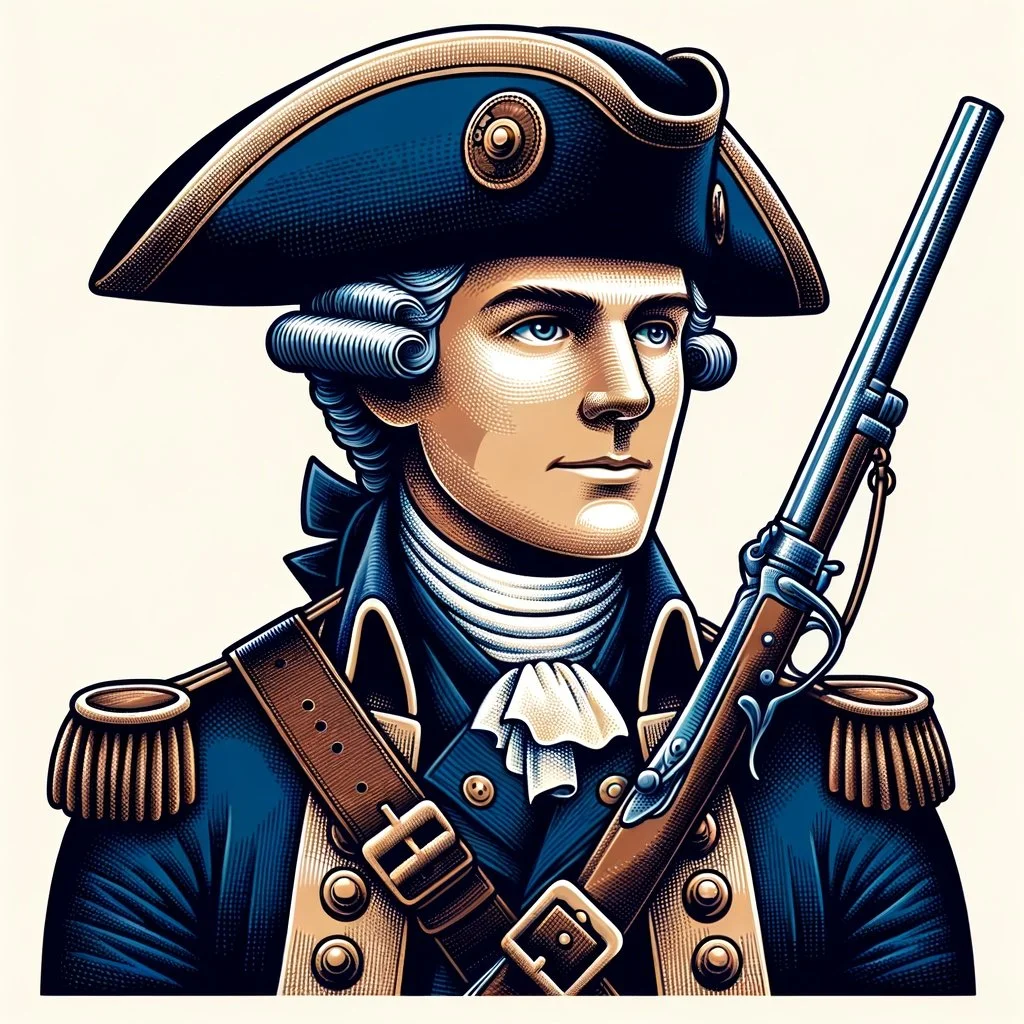
He was arrested and interrogated by the highest-ranking officer in the British Army, General William Howe, who got utterly nothing out of him but name, rank and an honest account of his purpose. For their patriotism, his last words remain unsurpassed. Spanish version here: https://informeorwell.com/opinion/un-heroe-que-los-estadounidenses-jamas-deben-olvidar-nathan-hale/.
Read MoreA Hero Americans Must Never Forget
A Hero Americans Must Never Forget
By Lawrence W. Reed
Have you ever received a letter that changed your life?
On the 4th of July 1775, a full year before the Second Continental Congress approved the Declaration of Independence in Philadelphia, a 20-year-old Connecticut man named Nathan Hale opened his mail to find just such a letter. It was from his Yale classmate Benjamin Tallmadge, who was on the front lines as a secret agent for the Americans while the British lay siege to Boston.
In Massachusetts, the eight-year War for Independence began at Lexington and Concord less than three months before. Hale, who had entered Yale College at the age of only 14, graduated with highest honors in 1773 and was just two years into what appeared to be a brilliant teaching career in Connecticut secondary schools. The letter from Tallmadge not only changed his life, but it also indirectly and prematurely ended it.
Published in 1941, George Dudley Seymour’s Documentary Life of Nathan Hale revealed what Tallmadge wrote to his friend at a critical moment. Hale was initially torn by the calling of his chosen career on the one hand and the urge to fight for America’s liberty on the other. This is the passage from the letter that settled the question:
I consider our country a land flowing as it were with milk and honey, holding open her arms and demanding assistance from all who can assist her in her sore distress. We all should be ready to step forth in the common cause. [Were] I in your condition, I think the more extensive service would be my choice. Our holy religion, the honor of our God, a glorious country, and a happy constitution is what we have to defend.
Tallmadge’s letter inspired Hale two days later to accept a commission as first lieutenant in Colonel Charles Webb’s 7th Connecticut Regiment. The teacher was now officially a soldier and a spy in a hastily organized, ragtag colonial army. The enemy? Nothing less than the world’s greatest military power. Fourteen months later, Hale would be dead at the age of 21 and enter American history as one of its bravest patriots. Tallmadge would go on to lead Washington’s famous Culper Spy Ring right up to the war’s end in 1783.
Of the many reasons to celebrate America’s 250th anniversary in 2026, honoring the sacrifice of this remarkable young man, Nathan Hale, ranks high on the list.
He was born in the Connecticut village of Coventry on June 6, 1755. His family earned a reputation for honor and integrity. Nathan’s father Richard was a successful farmer and church deacon who, according to one account, “instilled in his twelve children a deep sense of moral duty and community service.” Nathan lived up to those principles every day of his short life. His fellow soldier, Lt. Klisha Bostwick, described him thusly:
…I can now in imagination see his person and hear his voice—his person I should say was a little above the common stature in height, his shoulders of a moderate breadth, his limbs strait and very plump: regular features—very fair skin—blue eyes—flaxen or very light hair which was always kept short—his eyebrows a shade darker than his hair and his voice rather sharp or piercing—his bodily agility was remarkable. I have seen him follow a football and kick it over the tops of the trees in the Bowery at New York, (an exercise which he was fond of)—his mental powers seemed to be above the common sort—his mind of a sedate and sober cast, he was undoubtedly pious; for it was remarked that when any of the soldiers of his company were sick he always visited them and usually prayed for and with them in their sickness.…
Hale saw action in his first year in the army and by all accounts, performed admirably. In August 1776, General of the Army George Washington ordered Lt. Col. Thomas Knowlton to select an elite group of 150 men to gather field intelligence in contested areas. Young Nathan Hale was one of those 150. Known as Knowlton’s Rangers, these light infantry men were committing double treason—not only taking up arms against British forces but spying on the enemy as well. They were the early American predecessor to today’s special forces units such as Delta Force and Army Rangers.
After his defeat at Long Island on August 27, General Washington urgently needed information as to the placement and movement of the British forces that threatened Manhattan. He turned to Knowlton’s unit and asked for a volunteer. Only one man stepped forward, and that man was Nathan Hale.
According to historian David McCullough in his riveting book, 1776, Hale went undercover behind enemy lines in New York City disguised as a Dutch schoolteacher. He carried with him his Yale diploma bearing his name. He likely knew it was a suicide mission.
Details about Hale’s capture are a bit murky but it seems probable that just days into his daring venture, a Loyalist recognized Hale in a tavern and tipped off the British. He was arrested and interrogated by the highest-ranking officer in the British Army, General William Howe, who got utterly nothing out of him but name, rank and an honest account of his purpose. His requests for a Bible and a clergyman were denied. He was pronounced guilty and sentenced to death by hanging.
Seymour’s Documentary Life of Nathan Hale reveals a diary entry of a British officer named Frederick MacKensie. Of Hale, MacKensie wrote,
He behaved with great composure and resolution, saying he thought it the duty of every good Officer, to obey any orders given him by his Commander-in-Chief; and desired the spectators to be at all times prepared to meet death in whatever shape it might appear.
During the morning of the 22nd of September 1776, Nathan Hale marched under guard to a spot many believe was near today’s 66th Street and Third Avenue in Manhattan. Reports of what happened moments later are attributed to multiple British officers present at the execution. Permitted a few last words, the stalwart lad uttered this immortal line:
I only regret that I have but one life to lose for my country.
The British left Hale hanging for several days before burying him unceremoniously in an unmarked grave. Neither the site nor the body were ever found.
Shortly after Hale’s death, another American patriot named Eneas Munson Sr. composed “To the Memory of Captain Nathan Hale,” a poem in honor of the fallen hero:
Hate of oppression’s arbitrary plan,
The love of freedom, and the rights of man;
A strong desire to save from slavery’s chain
The future millions of the western main,
And hand down safe, from men’s invention cleared,
The sacred truths which all the just revered.
For ends like these, “I wish to draw my breath,”
He bravely cried, “or dare encounter death.”
And when a cruel wretch pronounced his doom,
Replied, “’Tis well, – for all is peace to come;
The sacred cause for which I drew my sword
Shall yet prevail, and peace shall be restored.
I’ve served with zeal the land that gave me birth,
Fulfilled my course, and done my work on earth;
Have ever aimed to tread that shining road
That leads a mortal to the blessed God.
I die resigned, and quit life’s empty stage,
For brighter worlds my every wish engage;
And while my body slumbers in the dust,
My soul shall join the assemblies of the just.”
The very schoolhouse in which Nathan Hale taught before enlisting in the Continental Army still stands in New London, Connecticut. Visit it when you’re in the area. When you do, think about the liberty you enjoy because of people like him.
For additional information, see:
Documentary Life of Nathan Hale by George Dudley Seymour
The Last Days and Valiant Death of Nathan Hale by American Heritage magazine
21-Year-Old’s Last Words Changed America Forever (video)
Happy Birthday, Freedom! – the brochure of the Free Society Coalition
(Lawrence W. Reed is President Emeritus, Humphreys Family Senior Fellow, and Ron Manners Global Ambassador for Liberty at the Foundation for Economic Education in Atlanta, Georgia. He blogs at www.lawrencewreed.com.)